
Textile & Apparel
Odoo for Textile and Garment Manufacturing
Odoo for spinning and weaving mills, fabric processors and garment manufacturers: styles with size and colour variants, a bill of materials per style, job work at dyers and stitchers, lot numbers per roll, and quality checks at every hand-off, on one system with sales, stock and accounts.
Last reviewed:
Textile & Apparel
- Odoo modules mapped
- 8 Odoo modules mapped
- case studies
- 2 case studies
- HS codes for export shipments
- Lot traceability for buyer audits
What decides the timeline on a textile or garment Odoo project?
The product master, more than any module. A garment business has to decide early which attributes create real variants in Odoo, usually size and colour, and which stay as plain descriptions, because every variant carries its own stock, barcode, cost and price. Get that wrong and the catalogue either explodes into combinations nobody sells or hides the ones that matter. The bill of materials follows: one per style, with component lines marked to apply only to the variants that use them, so the navy medium and the white large each pull the right fabric and trims. Job work comes next. Every dyer, printer or stitcher who takes your material becomes a subcontractor with a stock location of their own, so you can see what sits at each one. Lot design closes the loop: decide whether a lot is a roll, a dye batch or a production run before the first receipt, because traceability can only follow what you numbered.
Pain points & how Odoo solves them
| Challenge | How Odoo addresses it |
|---|---|
| Every style comes in many sizes and colours, and orders are typed line by line. | One product per style with size and colour attributes. Odoo's variant grid lets a sales or purchase user enter quantities for every size and colour of a style on one screen, and each variant keeps its own stock, barcode and price. |
| Nobody knows how much fabric and how many trims sit at the dyer, the printer or the stitching unit. | Odoo Subcontracting treats each job worker as a subcontractor with its own stock location. Fabric and trims go out on a resupply transfer, finished goods come back on a receipt, and stock at every job worker is visible in Inventory. |
| Costing a style means adding up fabric, trims, job-work charges and in-house labour by hand. | The bill of materials per style holds fabric, trims and operations. Job-work charges come from the subcontractor's price, and in Odoo 20 the manufacturing order's cost column includes subcontracted components, so cost per style is calculated rather than estimated. |
| A buyer's quality claim cannot be traced back to the yarn lot, the dye batch or the loom. | Lot tracking on yarn, greige, finished fabric and garments, with the traceability report showing upstream and downstream lots in one tree. Shree Mahadev Tex Fab ties finished-fabric sales to the production run, so a claim traces back to the loom. |
| Rejected pieces from a job worker are found at packing, not at receipt. | Quality control points on receipts from job workers and on in-house operations. A failed check sends the pieces to a failure location you choose, and Odoo 20 shows each vendor's quality rate on the vendor form and on purchase orders. |
| Fabric is bought in rolls and kilos but consumed in metres and pieces. | Units of measure on purchase, stock and the bill of materials, with lot quantities per roll, so a cutting order consumes metres from a specific roll and the remainder stays in stock under the same lot. |
| Mill, processing house, warehouse and shops each keep their own stock count. | Multi-warehouse Inventory with locations per stage: raw yarn store, weaving floor, finishing, finished goods, as Shree Mahadev runs it. Koskii runs company-owned stores, franchise stores and online orders on one Odoo with garment-level barcodes. |
How does a garment order move through Odoo?
One buyer order for a style in several sizes and colours, from the sales order to delivery. Each step names the Odoo app that runs it, with the Odoo 20 screen where there is one.
-
Odoo Sales
Take the order by style, size and colour
The buyer's order goes in through the variant grid: one style, a quantity for each size and colour. Every line is a variant with its own stock, barcode and price.
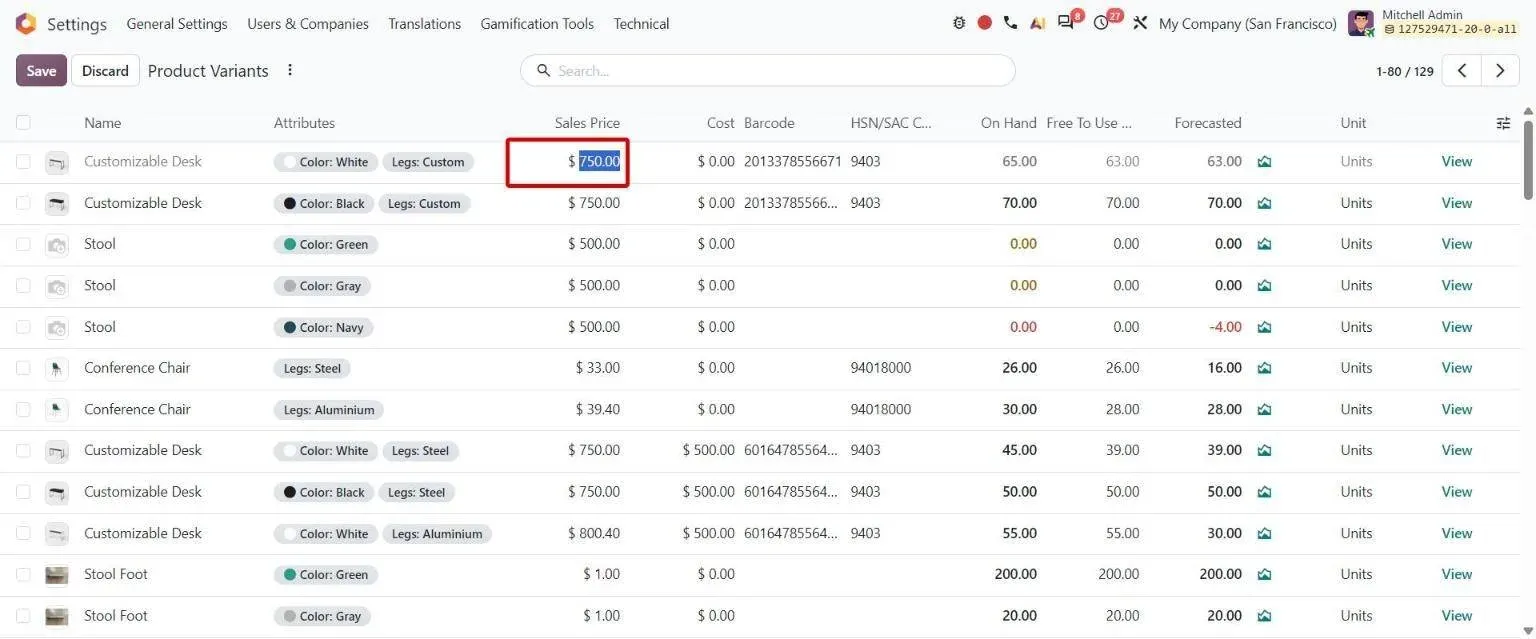
Product Variants list with Sales Price editable inline per variant -
Odoo Manufacturing
Plan production from the style's bill of materials
Confirming the order creates manufacturing orders from the style's BoM. Lines marked for specific variants pull the right fabric, thread and trims, and cutting, stitching and finishing become work orders at their work centers.
Odoo manufacturing (MRP)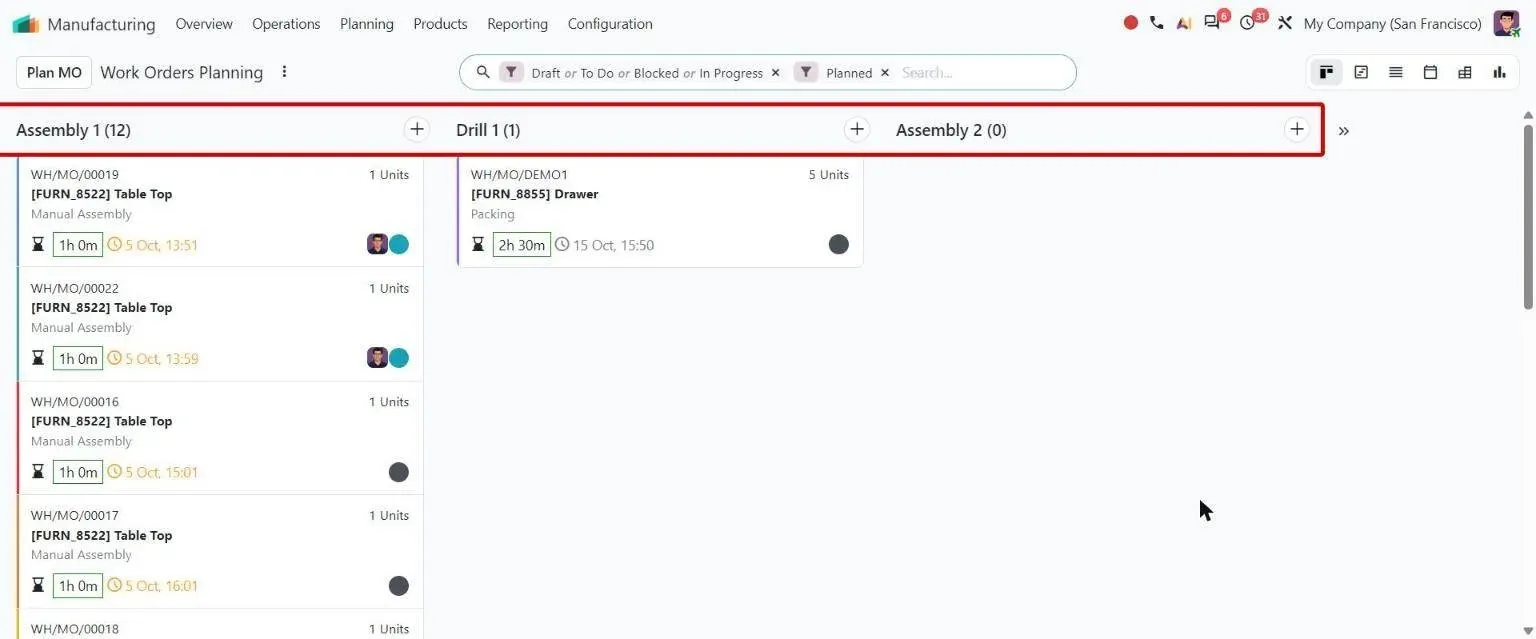
Work order Kanban grouped by work center columns -
Odoo Subcontracting
Send the job work out to the dyer or stitching unit
Outsourced steps run through Subcontracting. Fabric or cut pieces go to the job worker on a resupply transfer, or straight from the mill by subcontracting dropship, and stay in that job worker's stock location until the goods come back. The job-work charge comes from the subcontractor's price and shows in the order's cost.
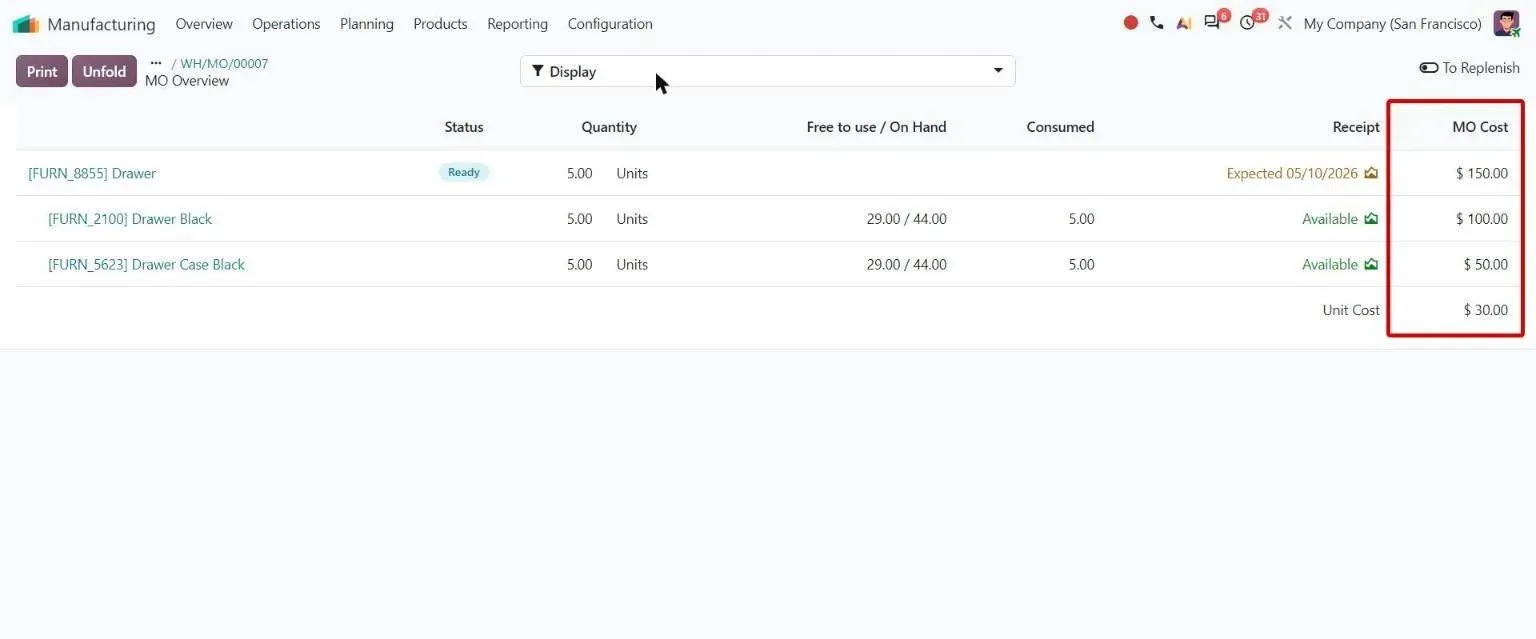
MO Overview with single MO Cost column and unit cost -
Odoo Quality
Check what comes back before it enters stock
A control point on the receipt from the job worker asks for a quality check. Pieces that fail go to the failure location set on the control point, so rejects are held apart from good stock.
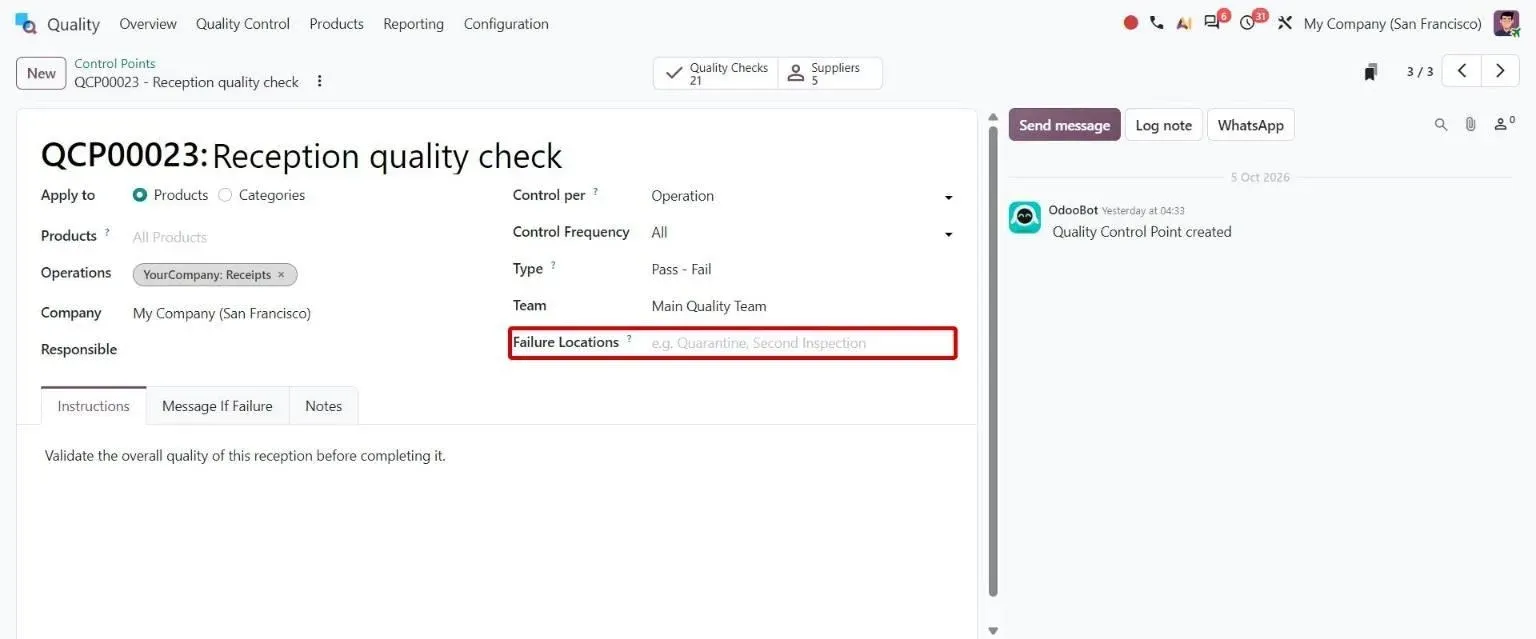
Control point form with new Failure Locations field -
Odoo Inventory
Store fabric and garments by lot and location
Rolls, dye batches and finished garments are stored under lot numbers, created when the manufacturing order is closed if nobody typed one. The traceability report follows any lot back to its yarn or fabric and forward to the customer.
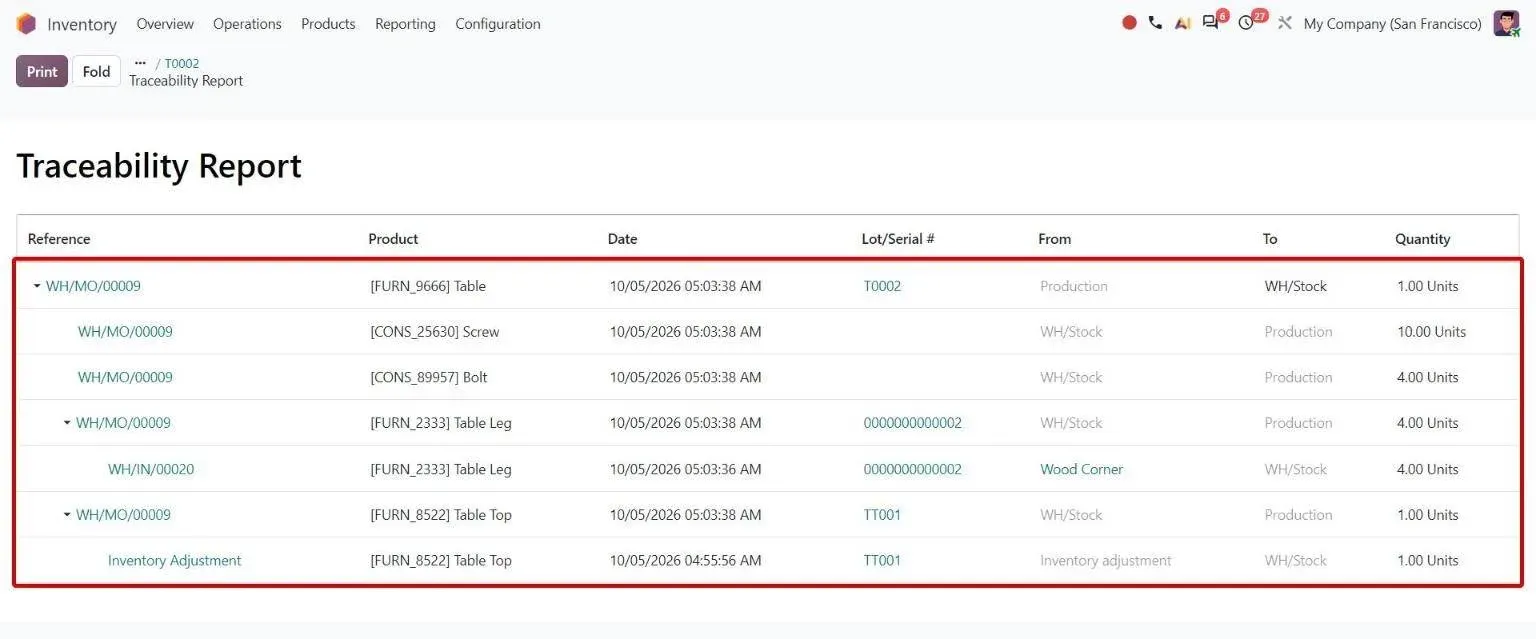
Unfolded lot traceability tree showing component origins with intermediate locations dimmed -
Odoo Accounting (India)
Raise the GST invoice, e-invoice and e-way bill
The invoice carries each product's HSN code and CGST and SGST or IGST for the place of supply. Odoo's India localisation submits the e-invoice for an IRN and generates the e-way bill from the invoice or from the delivery transfer, including goods sent to a job worker.
GST e-invoicing in Odoo -
Odoo Inventory + Accounting
Deliver and invoice
The warehouse picks and ships against the sales order, scanning barcodes where Barcode is in use. The invoice is created from the order, and its revenue and cost of goods sit on the same records as production and job work.
An illustrative journey across standard Odoo apps, not a client engagement. Screens are from the Odoo 20 feature guide on this site.
Which textile and garment manufacturers run Odoo with TechUltra?
These 4 companies list TechUltra as their Odoo partner on Odoo's partner directory under the industry label shown on each card (read on 5 November 2026). 1 of them has a full case study on this site. Work we delivered through other Odoo partners is credited to them and is not listed here.
- Shree Mahadev Texfab Pvt Ltd Odoo label: Manufacturing / Maintenance Case study: Shree Mahadev Tex Fab
- Earthen Textures Pvt Ltd Odoo label: Manufacturing / Maintenance Earthen Textures Pvt Ltd on Odoo's directory
- Leemboodi Fashion Odoo label: Wholesale / Retail Leemboodi Fashion on Odoo's directory
- Sai Om Texfab Private Limited Odoo label: Wholesale / Retail Sai Om Texfab Private Limited on Odoo's directory
Recommended Odoo modules
-
Manufacturing (MRP)
A bill of materials per style, routings for cutting, stitching and finishing, work orders by work center, and by-products for cut waste.
-
Subcontracting
Job work at dyers, printers, embroiderers and stitching units: material sent out, finished goods received back, stock tracked at each job worker.
-
Inventory + Barcode
Multi-warehouse stock, lot numbers per roll or dye batch, and barcode scanning on receipts, transfers and deliveries.
-
Quality
Control points at yarn and fabric receipt, after job work and before dispatch, with failure locations for rejected goods.
-
Sales
Quotations and orders through the variant grid, pricelists per buyer, and delivery against the order.
-
Purchase
Yarn, fabric and trims bought by lot, with vendor pricelists and the same variant grid for size and colour purchases.
-
PLM
Engineering change orders for style and BoM revisions between seasons, with the old and new BoM compared side by side.
-
Accounting
Invoices, payments and stock valuation from the same records as production and job work, with country tax localisation.
Which Odoo 20 apps do textile and garment manufacturers need?
| Odoo app | Module (edition) | What it holds |
|---|---|---|
| Sales | sale_product_matrix (Community) | Sales orders entered through a grid of a style's size and colour variants (sale.order, product_matrix) |
| Purchase | purchase_product_matrix (Community) | Yarn, fabric and trims bought by lot, and the same variant grid on purchase orders |
| Manufacturing | mrp (Community) | A bill of materials per style with lines applied to specific variants, routings and work orders (mrp.bom, mrp.bom.line, mrp.workorder) |
| Subcontracting | mrp_subcontracting (Community) | Job work: material sent to each job worker's stock location on the Resupply Subcontractor route, finished goods received back against the BoM |
| Subcontracting dropship | mrp_subcontracting_dropshipping (Community) | Fabric or yarn shipped by the supplier straight to the dyer or job worker |
| Inventory | stock (Community) | Warehouses and locations per stage, lots per roll or dye batch, the traceability report |
| Quality | quality_control (Enterprise) | Control points on receipts from job workers and on operations, failure locations, vendor quality rate (quality.point, quality.check) |
| PLM | mrp_plm (Enterprise) | Engineering change orders for style and BoM revisions between seasons (mrp.eco) |
| Barcode | stock_barcode (Enterprise) | Scanning garment barcodes and roll lots on receipts, transfers and deliveries |
What does Odoo 20 look like for textile and garment manufacturers?
Screens from Odoo 20 that textile and garment manufacturers use every day, from our Odoo 20 feature guide. Each one shows where to find it in Odoo and why it matters.
-
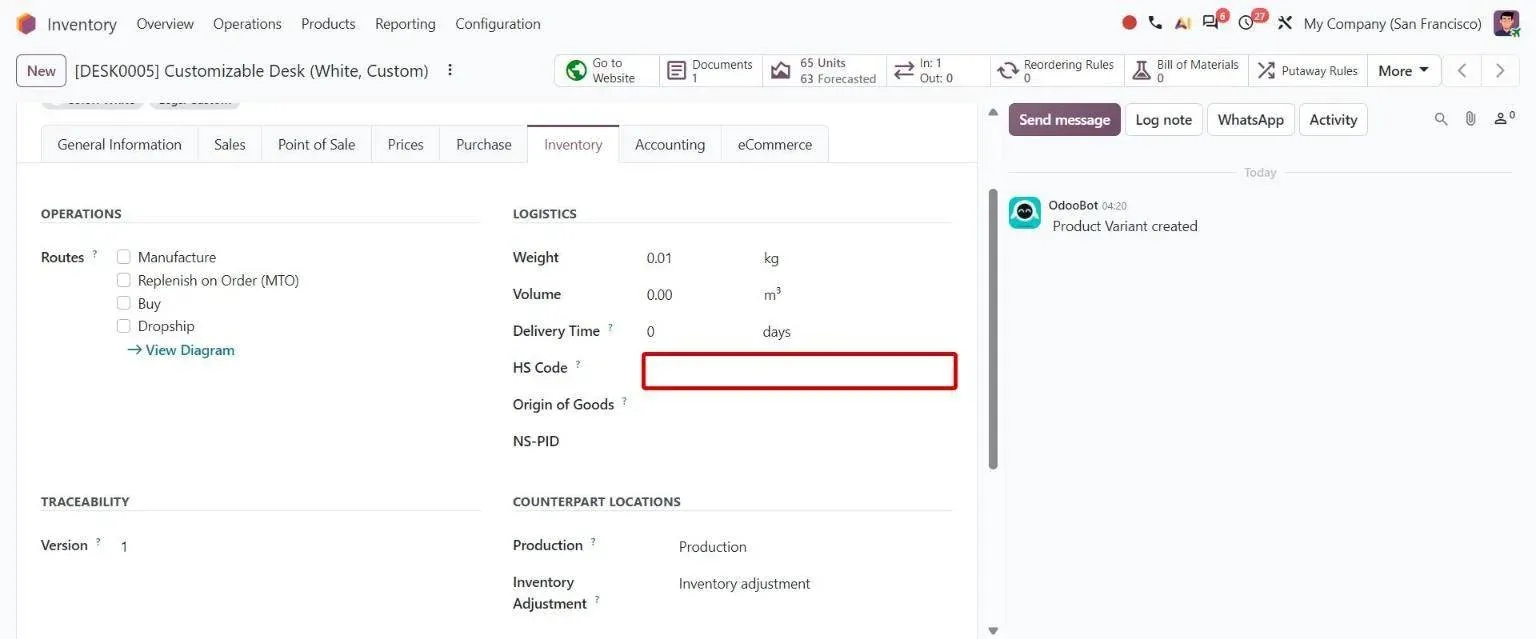
Product variant Inventory tab with its own HS Code field Odoo 20 · Inventory
Variant-specific HS codes
Inventory > Products > Product Variants
Helps customs documents stay accurate when product variants have different HS codes.
Variant-specific HS codes: how to use it in Odoo 20 -
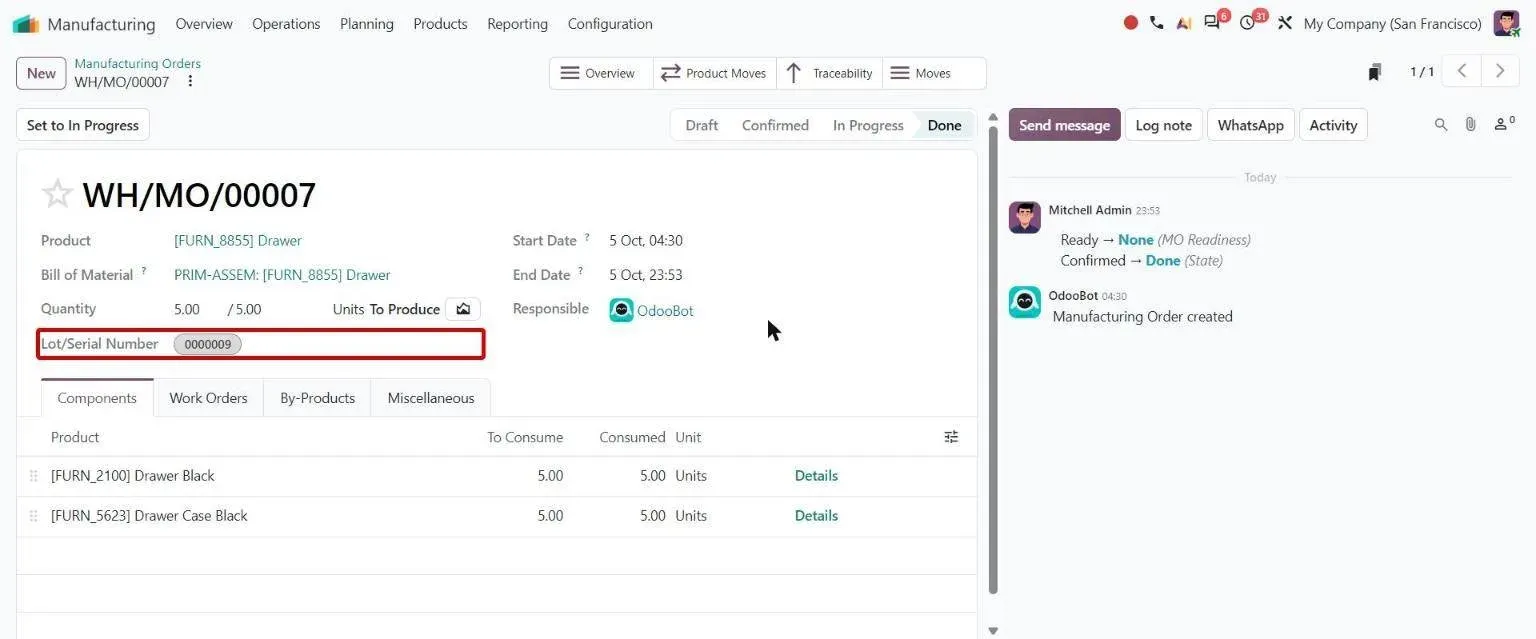
Done MO with lot number auto-generated on Produce Odoo 20 · Manufacturing
Generate lots and serials when closing manufacturing orders
Manufacturing > Operations > Manufacturing Orders > Produce
Saves operators time by generating lot and serial numbers automatically when closing an MO.
Generate lots and serials when closing manufacturing orders: how to use it in Odoo 20
Sample features
- One product per style with size and colour variants
- Variant grid on sales and purchase orders
- Bill of materials per style, with lines applied to specific variants
- Job work through Odoo Subcontracting, with stock at each job worker
- Fabric shipped from the mill straight to the dyer (subcontracting dropship)
- Lot numbers per roll, dye batch or production run
- Quality checks at receipt, after job work and before dispatch
- Cost per manufacturing order, including subcontracted components
- HS code per variant for export shipments (Odoo 20)
- Multi-warehouse stock across mill, processing, warehouse and stores
Use cases for textile and garment manufacturers
- Business process Plan-to-produce in Odoo 20 The eight steps from demand to a costed lot, the app that runs each one, and the gaps we usually close. Open
- Business process Order-to-cash in Odoo 20 From a quote or an online order to cash in the bank: credit checks, channels, returns and collections. Open
- Business process Warehouse inbound-to-outbound in Odoo 20 Receipts, put-away, picking and shipping, including Koskii's register per garment barcode. Open
- TechUltra app Bulk Add Products to Sale Order Add many products and variants to a sale order from one grid, with live stock and per-variant prices. Open
- TechUltra app Bulk Add to Cart A variant matrix on the eCommerce product page, so B2B buyers order every size and colour in one go. Open
- TechUltra app Mass Import Packages and Lot/Serial Numbers Paste packages, lots and serial numbers from a spreadsheet straight into Odoo receipts, deliveries, transfers and returns. Open
- Erpmate AI agents Erpmate for manufacturing Agents that check components before a date is promised, chase late purchase orders and flag BoM cost drift. Open
- Odoo 20 guide Odoo 20 inventory and manufacturing guide Every Odoo 20 change in Manufacturing, Inventory, Barcode, Purchase, PLM, Maintenance, Repairs, Shop Floor and Quality, with screenshots. Open
Compliance & regulatory
| Standard | What it requires |
|---|---|
| HS codes for export shipments | Textile and garment exports are declared by Harmonized System code. In Odoo 20 each product variant carries its own HS code, so variants that fall under different customs codes are declared correctly on export documents. |
| Lot traceability for buyer audits | Brand and retail buyers ask where a lot came from. Lot tracking from yarn or fabric receipt through job work to the finished garment answers that from the traceability report, without rebuilding it from paper. |
For businesses in India
Textile and garment ERP for manufacturers in India
For Indian mills, processing houses and garment units, the same Odoo runs GST, e-invoicing and e-way bills from the records that production and job work already create, so accounts do not wait for stock to be re-keyed.
- HSN on every product
- Odoo's India localisation adds an HSN/SAC code to each product, carried onto invoice lines. Koskii runs India GST by HSN across its stores on Odoo.
- GST by place of supply
- CGST and SGST within a state and IGST across states, applied from the customer's place of supply.
- E-invoice and e-way bill
- E-invoices submitted for an IRN, and e-way bills generated from an invoice or from a stock transfer, which covers fabric sent to a dyer or stitching unit.
- Job work in stock
- Material sent to and received back from job workers is tracked in stock through Subcontracting, so you can see what sits at every job worker.
- From Tally
- Shree Mahadev Tex Fab moved from Tally to Odoo 17 Enterprise, and now runs GST returns and vendor reconciliations from the same platform as inventory and production.
Which ERP software suits a garment manufacturing company in India?
One that keeps production, job work, stock and GST on the same records. Shree Mahadev Tex Fab left Tally because stock, sales and accounting sat on separate systems and textile workflows such as lot and dye-batch tracking could not be added. Odoo covers both sides: size and colour variants, a BoM per style, Subcontracting for job work, lot tracking, and India GST, e-invoicing and e-way bills in the same system.
Frequently asked questions
-
Is Odoo a good ERP for textile and garment manufacturing?
Yes, for mills, processors and garment makers that need production, job work, stock and accounts on one system. The parts the trade depends on are standard Odoo: product variants for size and colour, bills of materials with variant-specific lines, Subcontracting for job work, lot tracking and Quality. Where a mill needs more, such as dye-batch tracking, loom-shift productivity reports or a fabric-grade catalogue, we add it; those were customisations for Shree Mahadev Tex Fab.
-
How does Odoo handle job work with dyers, printers and stitchers?
Through Odoo Subcontracting. Each job worker is a vendor with a subcontracting bill of materials. When you send fabric or cut pieces, Odoo moves them to that job worker's stock location; when the finished goods come back, the receipt consumes the components and adds the finished product to stock. In Odoo 20 a receipt from a subcontractor without a purchase order is valued at the subcontractor's price list, and the manufacturing order cost includes subcontracted components.
-
Can Odoo manage size and colour variants for garments?
Yes. A style is one product with size and colour as attributes, and each combination is a variant with its own stock, barcode, cost and price. Sales and purchase users enter quantities through a grid of the style's variants instead of one line per size, and a bill of materials line can apply to only the variants that use it, such as a different thread colour per shade.
-
Can Odoo track fabric by roll and by dye batch?
By roll, yes, as standard: give each roll a lot number with its quantity in metres, and every cut consumes from a named roll. A dye batch can be the lot itself, or a field on the lot; Shree Mahadev's lot-level dye-batch tracking was a customisation on top of standard lot tracking. The traceability report then follows a lot upstream to its yarn and downstream to the customer.
-
Do we need Odoo Enterprise or is Community enough?
Manufacturing, Inventory, Purchase, Sales, Subcontracting and the variant grid are Community modules. Quality, PLM, Barcode and Shop Floor are Enterprise. Most garment and textile manufacturers want Quality at job-work receipts and barcode scanning in the warehouse, which makes Enterprise the usual choice.
-
How long does a textile Odoo implementation take?
Shree Mahadev Tex Fab went live in 16 weeks with six modules: Sales, Purchase, Inventory, Manufacturing, Accounting and Quality. The time goes mostly into the product master and bills of materials, which have to be built with your production team before anything can be tested. See how we run manufacturing projects on Odoo for manufacturing.
-
Can we move from Tally to Odoo?
Yes. Shree Mahadev moved from Tally to Odoo 17 Enterprise with a re-designed chart of accounts and a cutover at the fiscal-year boundary. Tally manufacturing entries do not map to Odoo bills of materials, so those are rebuilt with your team. The Tally to Odoo migration playbook sets out what moves across and in what order.
-
Does Odoo work for apparel brands that also run stores?
Yes. Koskii, an Indian fashion brand with more than 22 stores, replaced four systems with Odoo 17: garment-level barcodes on every sale, return and transfer, company-owned and franchise stores, and online orders on one stock ledger. See Odoo for retail for the store side.
-
What does a textile or garment Odoo implementation cost?
Implementation starts from about USD 4,000 and goes up with scope: the number of styles and variants, job workers, plants and warehouses, and any customisation such as dye-batch or loom reporting. You get a fixed price in writing after scoping. Odoo's own subscription is billed by Odoo; see Odoo pricing.