
Migration playbook
Migrate from Tally to Odoo
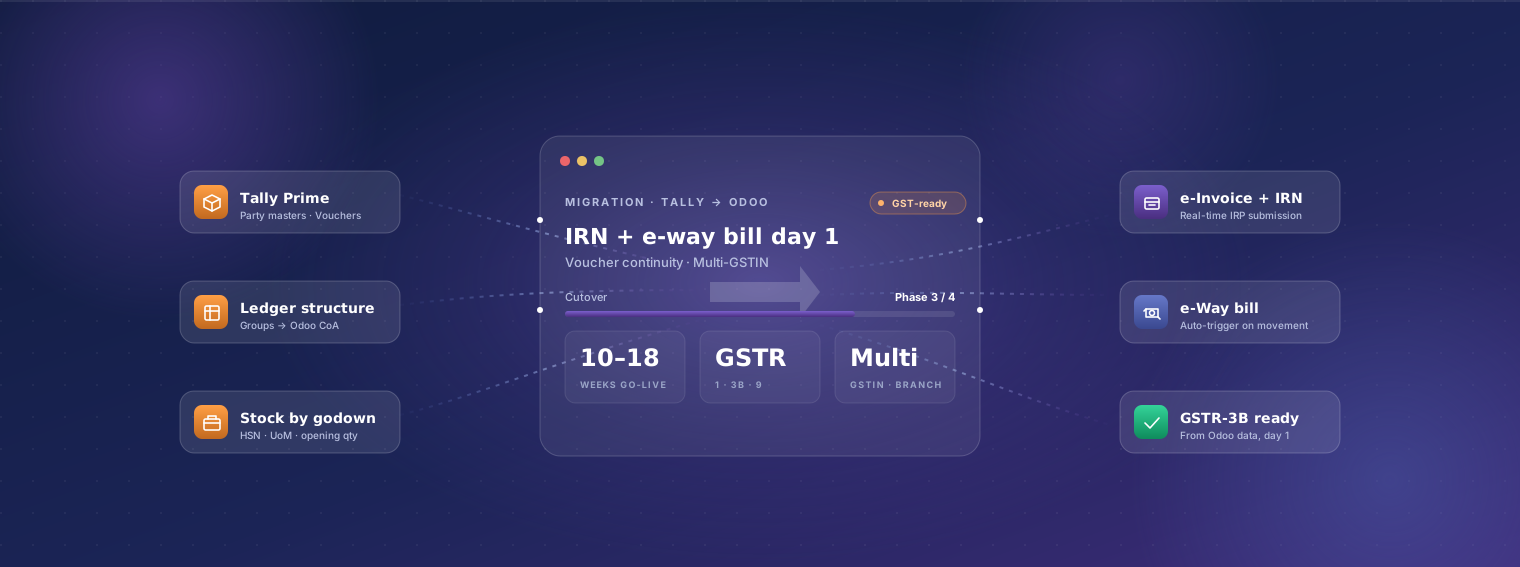
Tally is the right answer for a million Indian SMBs — and the wrong answer the day your operations stop fitting it. Multi-branch consolidation, GST e-invoicing at scale, real inventory and manufacturing, CRM and e-commerce — the moment you need any of these, the Tally workarounds start eating more time than the system saves. This is the playbook for moving to Odoo without losing your history or your GST chain.
Last reviewed:
- Weeks end-to-end
- 10–18Weeks end-to-endtypical mid-market scope
- Fixed-price range
- ₹8–35 lakhFixed-price rangeINR; USD 9,500–42,000
- Weeks parallel run
- 3–4Weeks parallel runboth systems live
Why businesses migrate from Tally to Odoo
-
Multi-branch / multi-location operations
Tally's multi-branch model is one company file per branch with manual or scripted consolidation. Once you have 3+ branches, the consolidation pain compounds — different teams, different data quality, monthly reconciliation that takes a week. Odoo handles multi-branch on one database with real-time consolidation.
-
GST e-invoicing at scale
Tally generates IRN-compliant e-invoices, but high-volume B2B operators (5,000+ invoices/month, multi-state operations, multiple GSTINs) hit operational limits: bulk submission queues, e-way bill triggers, IRN cancellation edge cases. Odoo's GST localization runs production e-invoicing for businesses well past those volumes.
-
Inventory and warehouse depth
Tally inventory is single-method, with light location tracking. Multi-warehouse stock, putaway rules, replenishment min/max, batch and serial tracking, advanced costing (FIFO/LIFO/weighted average per location) — these either don't exist or work through Excel exports. Odoo Inventory handles all of this natively.
-
Manufacturing — BOMs, work orders, MRP
Tally manufacturing is voucher-driven and accounting-first. Real shop-floor operations — multi-level BOMs, routings, work orders, MES integration, quality control, maintenance — sit outside Tally entirely. Odoo Manufacturing handles MRP I and MRP II natively.
-
CRM, sales pipeline, marketing
Tally is a system of record, not a system of revenue. Sales pipeline, lead qualification, quotation versioning, email marketing, customer 360 — all live in spreadsheets or third-party SaaS. Odoo CRM, Sales, and Marketing share the same database as accounting.
-
E-commerce and modern integrations
Tally connectors to Shopify, Amazon, Flipkart, Razorpay etc. exist via partner add-ons but are brittle — versions drift, sync breaks, reconciliation suffers. Odoo's CRM, e-commerce, and accounting are native; integrations to payment gateways and marketplaces are first-party or partner-grade with active maintenance.
-
User and access controls
Tally's user model is shallow — most operations are role-based but audit trails and approval workflows are thin. As teams grow past 15–20 users, segregation of duties and approval chains become hard to enforce. Odoo's RBAC, approval workflows, and audit log give finance and operations real control.
-
Reporting and analytics
Tally's reports are fast and useful for finance basics, but operational reporting (customer cohort analysis, project profitability, multi-dimensional analytics) requires data export and Excel work. Odoo's dashboards, Spreadsheet view, and Studio give the same teams better answers without leaving the system.
What survives the migration
Plain-English breakdown of what we move, what we re-map, and what gets rebuilt in Odoo's framework rather than ported.
| Data category | Coverage | Detail |
|---|---|---|
| Party masters (customers + suppliers) | Fully migrated | All sundry debtor and sundry creditor ledgers migrated as Odoo contacts, with GSTIN, PAN, addresses, contact persons, payment terms, opening balances. De-duplication during migration — Tally party masters typically have 5–20% duplicates after a few years of use. |
| Stock items | Fully migrated | Stock items with HSN/SAC codes, units of measure, opening quantities by godown, costs, prices, GST rates. Tally's stock-group hierarchy maps to Odoo's product categories. |
| Ledger structure / chart of accounts | Partial / mapped | Tally's group hierarchy (Direct Income, Indirect Income, etc.) re-mapped to Odoo's chart of accounts with your auditor's input. India-localization CoA in Odoo gives you the right structure for GSTR-1, GSTR-3B, and ITC reconciliation out of the box. |
| Opening balances (financial) | Fully migrated | Bank balances, cash balances, AR, AP, fixed assets, loans, capital — reconciled to a specific cutover date. Your CA signs off before cutover. |
| Stock opening balances | Fully migrated | Opening quantities by item by godown, with cost. Costing method re-selected in Odoo to match policy. We reconcile to Tally's stock summary to the rupee before cutover. |
| Voucher history (1–3 years) | Partial / mapped | Sales, purchase, payment, receipt, journal, contra, and credit/debit notes migrated for 1–3 years for historical reporting. Older history stays in a read-only Tally archive — cheaper than migrating 8 years of vouchers. |
| Voucher numbering | Fully migrated | Odoo number sequences pick up where Tally left off, so customers and auditors see continuity. Sales invoice, purchase invoice, journal voucher, payment voucher, receipt voucher — all keep their existing schemes. |
| GST registrations and configurations | Fully migrated | GSTINs, place of supply, HSN code rates, RCM applicability, composition scheme status — all migrated as Odoo's India localization is GST-native. GSTR-1, GSTR-3B, GSTR-9, ITC reconciliation work day one. |
| TDS / TCS configurations | Fully migrated | Tax-deducted-at-source and tax-collected-at-source rules migrated with vendor/customer tagging. TDS deduction during AP runs and TDS return filing (26Q, 27Q) work natively. |
| Bank reconciliation history | Partial / mapped | Outstanding (unreconciled) bank items migrated. Historical reconciled items stay in the Tally archive; Odoo starts fresh from cutover with bank feed integration where supported (most Indian banks have direct or via account-aggregator integration). |
| Bills of materials (manufacturing) | Rebuild in Odoo | Tally manufacturing entries are voucher-based and don't map cleanly to Odoo's BOM/routing model. We document each finished good's recipe with your production team and rebuild as Odoo BOMs — typically a 1–2 week exercise that produces a cleaner manufacturing setup than was in Tally. |
| Custom Tally TDL / reports | Rebuild in Odoo | TDL (Tally Definition Language) customizations don't port. We catalog what each TDL does and rebuild as Odoo native — usually fewer customizations because Odoo's defaults cover much of what TDL was bolted on for. |
| Cost centres | Fully migrated | Tally cost centres map to Odoo's analytic accounting (a different model but functionally equivalent). Multi-dimensional analytics in Odoo are actually richer than Tally's cost-centre hierarchy. |
| User accounts and permissions | Rebuild in Odoo | Users re-created in Odoo's role-based model. Migration is typically a chance to tighten permissions that loosened over time in Tally — segregation of duties, approval limits, etc. |
Our phased approach
-
Discovery week
1 week, fixed-priceSenior consultant audits your Tally company file(s), business processes, GST compliance setup, and target Odoo scope. Output: written migration plan + fixed-price quote. Includes sample data extraction to test migration scripts against your actual file.
-
Sandbox migration
4–7 weeksWe build migration scripts against your Tally data export (XML / ODBC), run them into a sandbox Odoo instance, and reconcile balances and stock to the rupee. Your finance team validates party masters, ledger structure, opening balances, and a representative sample of vouchers.
-
Odoo configuration in parallel
3–6 weeks (overlapping)While migration is being refined: India GST localization, e-invoicing (IRN + e-way bill), TDS / TCS workflows, multi-branch / multi-GSTIN setup, approval chains, and any custom modules (CRM, e-commerce, manufacturing) configured per your scope.
-
User training
1–2 weeksRole-based training (accounts, sales, purchase, stores, branch managers) with hands-on time in sandbox Odoo. Recorded modules in English + Hindi where useful. Goal: every user has done their job in Odoo at least three times before go-live.
-
Cutover weekend
1 weekendTally closes for new vouchers on Friday evening. Final migration (closing balances, last few days of vouchers) runs Saturday. Reconciliation Sunday with CA sign-off. Monday morning: team starts in Odoo.
-
Parallel-run period
3–4 weeksBoth Odoo and Tally accessible. New vouchers in Odoo only; Tally read-only. We monitor every operational flow, fix anything that surfaces, validate GST returns for the parallel month, and decommission Tally only after the GSTR-3B filing reconciles cleanly.
-
Stabilisation
30 days post go-liveOn-call engineering, weekly status, and fast fixes. By day 30 the team has filed at least one GSTR return from Odoo, finance has closed a month-end, and we move into normal support.
Typical timeline
10–18 weeks end-to-end for a typical mid-market migration. Variables: (1) data volume — a 5-year Tally Prime file across 4 branches takes longer than a 2-year single-branch file; (2) GSTIN count — each additional GSTIN adds configuration time for e-invoicing, e-way bill, and returns; (3) manufacturing depth — if BOMs and routings need rebuilding, add 2–3 weeks. We commit to a specific timeline at the end of discovery, not before.
Indicative cost
INR 8–35 lakh (USD 9,500–42,000) fixed-price for end-to-end migration + Odoo go-live, depending on data scope, branch count, GSTIN count, and custom development. Discovery week itself is INR 75,000–1.5 lakh fixed (USD 900–1,800), deductible from the full project quote. Add INR 3–8 lakh for substantial integrations (e-commerce, payment gateway, banking API, manufacturing). Compare to multi-branch Tally + add-on tools + manual consolidation effort: typically INR 6–15 lakh/year of license + manual ops cost, with the same functional ceilings.
Risks and mitigations
-
Risk: Data hygiene from years of Tally use
Mitigation: Discovery week always includes a data audit — duplicate party masters, mis-grouped ledgers, missing HSN codes, GSTIN format issues. Anything systemic gets cleaned in source or via cleaning scripts before migration. The audit reveals issues most teams suspected but hadn't quantified.
-
Risk: Voucher numbering continuity break
Mitigation: Odoo number sequences are configured to continue Tally's series — sales invoice, purchase invoice, JV, payment, receipt all pick up where Tally left off. We test this in sandbox before cutover. A number-jump on a sales invoice would confuse a customer and an auditor; we treat continuity as non-negotiable.
-
Risk: Multi-GSTIN reconciliation
Mitigation: Companies with multiple GSTINs (multi-state operations) need explicit GSTIN-to-entity mapping in Odoo. We design this up-front in discovery and validate the GSTR-1 / GSTR-3B output for each GSTIN before cutover. Multi-GSTIN setups are the case where most Tally-to-Odoo migrations actually gain the most operational lift.
-
Risk: GST e-invoicing turnover threshold transition
Mitigation: If you cross the e-invoicing turnover threshold (currently INR 5 crore aggregate turnover) during the migration, e-invoicing configuration is part of the migration, not a separate project. We provision IRN credentials, e-way bill setup, and run test transactions in sandbox before production. Many migrations are triggered by exactly this threshold transition.
-
Risk: Manufacturing BOM rebuild scope
Mitigation: BOM rebuilding requires production-team time we don't control. We schedule explicit BOM-walkthrough sessions in discovery to estimate the count and complexity, and budget production-team availability into the timeline. Hiding this risk causes more delays than facing it.
-
Risk: TDL customization gap
Mitigation: Every Tally deployment of any age has TDL — custom reports, custom voucher types, custom validations. We require a TDL inventory during discovery: each TDL's purpose, the user(s) who rely on it, and the business outcome it produces. Most TDLs disappear (Odoo defaults cover the need) or get rebuilt as Odoo native customizations.
-
Risk: CA / auditor sign-off timing
Mitigation: Reconciliation requires CA sign-off — both on cutover-day closing balances and on the first GSTR filing from Odoo. We schedule these explicitly with your CA in the timeline. Mid-FY migrations (April–September is preferred) make this cleaner; year-end migrations (Q4) compress the sign-off window dangerously.
-
Risk: Branch-level user adoption
Mitigation: Branch operators are usually the last to be consulted in a migration project — and the first to push back when their familiar Tally screen disappears. We deliberately involve at least one branch user per region in discovery and training, in Hindi or the local language where appropriate. The branch-level lift is harder than the HO lift; budget for it.
Who should migrate
Indian SMB and lower-mid-market businesses (15–500 users) currently on Tally Prime or Tally ERP 9 where the platform is no longer keeping up. Particularly strong fit for: multi-branch retail, distribution, and FMCG operators; manufacturers needing real MRP; multi-GSTIN groups; B2B operators above the GST e-invoicing turnover threshold; businesses adding e-commerce or modern CRM that Tally can't unify. Smaller businesses (under 10 users) running simple Tally accounting are often a worse fit — the migration cost is hard to justify until operational pain becomes acute. Honest first call decides which side of the line you're on.
Frequently asked questions
-
Do you migrate from Tally Prime, Tally ERP 9, or both?
Both. Tally Prime exports via XML and ODBC cleanly; Tally ERP 9 exports via XML and the older ODBC connector. Migration scripts handle both formats. Older Tally 4.5 / 5.4 / 6.3 / 7.2 files can be migrated but usually we recommend upgrading to Tally Prime first (a free Tally upgrade) to get a clean export, then migrating to Odoo.
-
Will our GST e-invoicing (IRN) and e-way bill keep working on day one?
Yes. Odoo's India localization handles IRN generation, GSTN portal submission, e-way bill generation, and IRN/QR code printing on invoices. We provision IRP / GSP credentials during the migration, run test transactions in sandbox, and validate against your existing GSTIN(s) before cutover. The first IRN-stamped invoice from Odoo is typically issued within hours of go-live.
-
What about GSTR-1, GSTR-3B, GSTR-9 returns?
Odoo's GSTR-1 and GSTR-3B reports generate in the GSTN portal format from native Odoo data — no separate compliance tool. GSTR-9 (annual return) aggregates from the same data. ITC (Input Tax Credit) reconciliation between GSTR-2B and books happens in Odoo with auto-matching. Most clients file their first GSTR from Odoo within the first calendar month of go-live.
-
Can we keep using Tally read-only after migration?
Yes — and we recommend it for 1–2 years (covering at least one full audit cycle). Tally Prime continues to run locally as read-only reference; historical vouchers stay searchable. After your CA confirms the cutover-period audit passes cleanly, most clients decommission Tally on a planned date.
-
How does TDS / TCS work in Odoo vs Tally?
Odoo's India localization handles TDS deduction during AP processing (per Section 194 etc.) and TCS collection during AR (per Section 206C). Vendor / customer tagging governs applicability; TDS return generation (26Q, 27Q) outputs in the format the TDS return utility ingests. The day-to-day flow is faster than Tally because the calculations happen at voucher entry, not as a separate end-of-month exercise.
-
We have a complex Tally TDL setup — can it be migrated?
TDL itself doesn't port (different platform, different language). What we do is catalog every TDL during discovery, classify each as 'replace with Odoo default' (60–80% typically), 'rebuild as Odoo customization' (15–30%), or 'no longer needed' (10–20%). The rebuilt TDLs become proper Python customizations that survive Odoo upgrades — TDL didn't survive Tally upgrades cleanly either.
-
What about Tally on a thin-client / shared network setup?
Common in branch operations. We migrate from the central Tally file the network points at. After migration, Odoo can run on Odoo.sh (cloud, recommended for multi-branch) or self-hosted on a local server — eliminating the thin-client architecture entirely. Branch users get direct browser access from any location.
-
Will our regional language data (Hindi, Tamil, etc.) migrate cleanly?
Yes. Tally supports Unicode for party names, item names, addresses; Odoo is fully Unicode and supports multi-language UI. Regional language data migrates unchanged. Invoice templates can be set bilingual (English + regional language) where required.
-
What's the right time of year to migrate?
April–September is the sweet spot — fresh FY, no Q4 closing pressure, clear runway to next March's year-end. October–December is workable. January–March is the worst window: year-end close, tax filings, and audit pressure compete for the same finance-team hours. If you must migrate in Q4, we structure the cutover for April 1 (FY start) and run sandbox + training in February–March.
-
What about multi-currency for export businesses?
Tally multi-currency is functional but basic. Odoo handles multi-currency natively with real-time exchange rates (RBI feed configurable), FX gain/loss accounting, foreign bank accounts, and INR-denominated GST on foreign-currency invoices. For exporters claiming GST refund under LUT, the Odoo workflow is significantly cleaner than Tally + spreadsheets.
-
Do you handle ZATCA / FatturaPA / other foreign localizations during the migration?
If your business operates outside India as well (Saudi entity, UK entity, etc.), we configure those localizations on the same Odoo instance. Multi-company multi-country is native — one Odoo handles your India GST and your Saudi ZATCA and your UK MTD VAT from one database, with appropriate consolidation.
-
What's the very first step?
A 30-minute call. Three questions: how many users + branches + GSTINs, what's the current Tally version, and what's the top operational pain. From that we can tell you whether discovery week is worth scheduling and what the realistic project size is.