
Pricing
Odoo pricing — what it really costs in 2026
License + implementation + ongoing support — honest numbers, by company size, with the levers that move them up or down. No "contact us" walls; the ranges are real and the calculators are linked.
Last reviewed:
What actually drives the cost of an Odoo project?
The number that matters is not the licence, it is the three-year total. Licences are the smallest line: at 50 users Enterprise runs roughly USD 15,000 to 23,000 a year, while implementation lands once at USD 30,000 to 90,000 and support runs continuously underneath. Budget the ratio, not the headline. Two things move the implementation figure more than user count: how many processes you change to fit Odoo rather than changing Odoo to fit them, and how clean your opening data is. Migrating a decade of inconsistent product master data has ended more project timelines than any feature gap. Treat any quote produced without a discovery phase as a guess, because it is one. Ask instead what the fixed price covers, what triggers a change order, and what happens in the first ninety days after go-live, when the real cost of a cheap implementation usually arrives.
How much does Odoo cost per user?
Three editions; the choice between them is the single biggest license-cost lever.
-
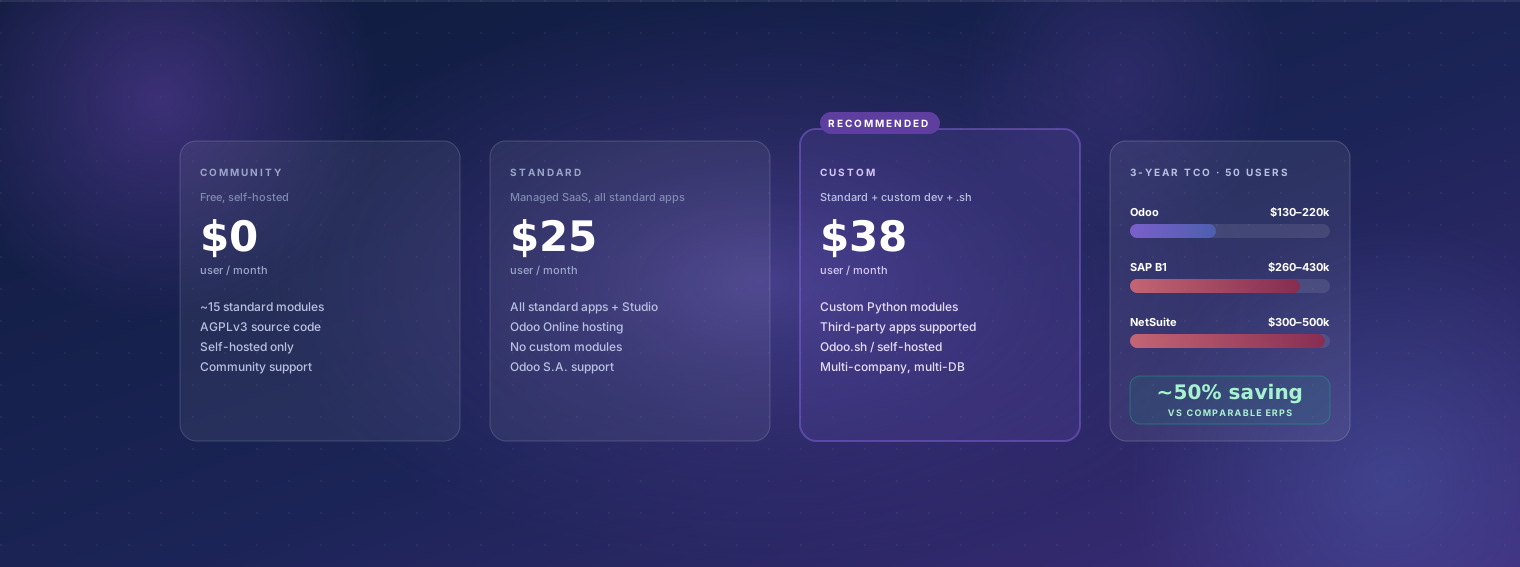
Community
Free, self-hosted, open source
USD 0 / user / month
- LGPLv3 source code, full access
- ~15 standard modules (CRM, Sales, Inventory, basic Accounting, HR, Project, …)
- Self-hosted only — your servers or cloud
- Community + partner support
- Manual upgrades managed by you / partner
-
Enterprise — Standard
Cheapest managed Odoo with all standard apps
USD ~25 / user / month
- All standard apps including Studio, full Accounting, MRP
- Hosted on Odoo Online (managed SaaS)
- No custom developments, no third-party apps
- Odoo S.A. support included
- Automatic upgrades
-
Recommended
Enterprise — Custom
Standard + customization + flexible hosting
USD ~38 / user / month
- Everything in Standard
- Custom developments and third-party apps supported
- Multi-company, multi-database
- Hosted on Odoo Online, Odoo.sh, or self-hosted
- Recommended for any partner-led mid-market deployment
Per-user prices reflect typical 2026 list pricing in USD. Regional pricing varies — INR, EUR, GBP, AED, SAR all have local list prices. Multi-year prepayment discounts of 5–15% are typical.
How much does Odoo implementation cost by company size?
Indicative bands for a typical mid-market implementation (4–8 modules, light customization, 1–3 integrations). Real quote comes from discovery; the band is what to budget against.
| Company size | Indicative band | Typical scope |
|---|---|---|
| Up to 10 employees | USD 8,000 – 18,000 | 1–3 core modules, light customization, 4–8 week timeline. |
| 11 – 50 employees | USD 18,000 – 45,000 | 4–6 modules, moderate customization + 1–2 integrations, 8–14 week timeline. |
| 51 – 250 employees | USD 35,000 – 90,000 | 6–10 modules, data migration, multiple integrations, 12–20 week timeline. |
| 251 – 1,000 employees | USD 70,000 – 180,000 | Full functional coverage, multi-entity, complex integrations, 16–28 week timeline. |
| 1,000+ employees | USD 140,000+ | Programme-led, multi-phase, regional rollouts, 24+ week timeline. |
What makes an Odoo project cost more or less?
Seven levers explain almost all the variance within an implementation band.
-
Module count
Implementing CRM + Sales is meaningfully different from implementing CRM + Sales + Inventory + Manufacturing + Accounting + HR + Project + Helpdesk. Each module adds configuration, testing, and training time.
-
Data migration
Greenfield (no historical data) is fastest. Migrating from QuickBooks, Tally, or Sage adds 3–6 weeks. Migrating from SAP Business One or NetSuite adds 6–10 weeks, plus a parallel-run period.
-
Integrations
Each integration (Shopify, Salesforce, banks, payment gateways, e-invoicing portals, EDI partners) is its own scope. Low-effort native connectors are 1–2 weeks; custom integrations are 3–6 weeks each.
-
Customization depth
Standard Odoo + Studio configuration is fastest. Custom Python modules — regulatory specifics, unique workflows, bespoke automations — extend timeline and add maintenance cost. We push back on customization when standard would do.
-
Country / regulatory complexity
Each country localization (India GST, UK MTD VAT, Saudi ZATCA, France 2026 e-invoicing, Italy FatturaPA, Mexico CFDI) adds setup work. Multi-country deployments compound.
-
User count and roles
More users means more training, more permission groups, more role-based testing. Doubling user count doesn't double cost, but it's not linear-zero either.
-
Discovery rigour
We always start with a paid discovery week (USD 2,500–4,000 fixed) that produces the fixed-price quote. Skipping discovery to save 1 week of cost is the most common reason mid-market implementations overrun by 40%.
How much does Odoo cost to run each year?
Implementation is one-time. Ongoing support is recurring — usually the larger lifetime cost. Pick the model that fits how active your Odoo evolution will be post go-live.
-
Community
Free, self-managed. Reasonable for businesses with in-house Odoo skills, simple deployments, and no urgency on regulatory updates. Practical ongoing cost is the time your team spends.
-
Partner retainer (light)
USD 1,500–4,000/month for 8–20 hours of senior consultant time. Covers user questions, light enhancements, version-upgrade prep. Right for stable deployments with occasional needs.
-
Partner retainer (active)
USD 4,000–12,000/month for 30–80 hours. Covers ongoing module additions, regulatory updates, integration work, and SLA-backed incident response. Right for businesses actively growing into Odoo.
-
Dedicated developer
USD 4,500–9,000/month for a named senior Odoo developer working as an extension of your team. Right for businesses with continuous custom-module needs (often manufacturers, multi-entity groups, regulated finance).
What's the 3-year TCO of Odoo vs NetSuite vs SAP B1?
Apples-to-apples for a 50-user mid-market business, year one through year three. Numbers are ranges; your specifics fall within them.
| Cost component | Odoo | NetSuite | SAP Business One |
|---|---|---|---|
| Year 1 license (50 users, Enterprise Custom) | ~USD 22,800 | ~USD 60,000 | ~USD 50,000 |
| Year 1 implementation | USD 35,000–75,000 | USD 90,000–200,000 | USD 80,000–180,000 |
| Annual ongoing license (years 2+) | ~USD 22,800 | ~USD 60,000+ (escalators) | ~USD 50,000+ (~17% maintenance + escalators) |
| Annual partner support (light) | USD 18,000–36,000 | USD 30,000–60,000 | USD 25,000–50,000 |
| Three-year TCO estimate | USD 130,000–220,000 | USD 300,000–500,000 | USD 260,000–430,000 |
Sources: Odoo list pricing 2026 (odoo.com); NetSuite and SAP B1 ranges aggregated from published partner quotes and analyst reports. Real quotes vary by region, currency, and commercial terms.
Frequently asked questions
-
How much does Odoo really cost for a 50-user business?
License (Enterprise Custom, 50 users): around USD 22,800/year. Implementation (one-time, 6 modules, 2 integrations, light customization): USD 35,000–75,000 typical. Ongoing partner support (light): USD 18,000–36,000/year. Total year-one investment: USD 75,000–135,000 for a mid-market deployment. Year-two onwards: USD 40,000–60,000 recurring.
-
Is Odoo Community really free?
Yes — the license is free under LGPLv3. The catches: self-hosting cost (infrastructure + ops + security patching), missing premium modules that you either rebuild or do without, and no direct Odoo S.A. support. For a 50-user business, the true TCO of Community can equal Enterprise once you factor in those — sometimes cheaper, sometimes not. We model this honestly during discovery rather than defaulting to Enterprise.
-
What's the difference between Standard and Custom Enterprise plans?
Standard (~USD 25/user/month): all standard apps, hosted on Odoo Online, no custom developments, no third-party apps, no multi-company, no multi-database. Custom (~USD 38/user/month): everything in Standard plus custom developments, third-party apps, multi-company, multi-database, and choice of hosting (Online, Odoo.sh, or self-hosted). For any partner-led implementation with real customization, Custom is the right plan.
-
Do you do fixed-price implementations?
Yes — every project engagement (Implementation, Customization, Development, Migration, Integration, Training, Consulting) is fixed-scope, fixed-price after a paid discovery week. We don't do open-ended T&M project work. The only retainer engagements are ongoing support and embedded developers, which are monthly billing with hour buckets.
-
How accurate is the cost estimator?
The estimator at Odoo estimator and implementation estimator gives you a directional read based on team size, module count, and complexity. Real quotes after discovery typically land within 15% of the estimator output, sometimes lower. Use the estimator to budget and screen partners; use a discovery week to commit a number.
-
What's the cheapest way to get started with Odoo?
Odoo Online Standard plan, one or two apps, no customization, self-configured. For a 5-user business doing pure CRM + Invoicing, that's USD 125/month + your time. The cheapest partner-led starting point is a 4–6 week Success Pack engagement — fixed-price, scope-limited, ~USD 6,000–12,000. See Odoo Success Pack.
-
What does Odoo.sh hosting cost on top of the license?
Odoo.sh is sized by 'workers' (concurrent request processors) and storage. Small project (1 worker, 20 GB): around USD 60/month. Mid-market (4 workers, 100 GB): around USD 240/month. Larger (8+ workers, 500 GB): USD 500–1,000+/month. Compare to Odoo Online (Custom plan): hosting included in per-user license fee, no separate charge.
-
Are there any hidden costs?
The honest ones that catch people: country-specific localization modules (most are free, some specialized ones cost), Odoo App Store third-party apps (typical app: USD 200–800 one-time or USD 25–100/month), integration platform fees for some EDI partners, and bank-feed services in regions where Odoo's native feeds don't cover your bank. We surface every one of these during discovery — no surprises after contract.
-
How does Odoo pricing compare to NetSuite or SAP Business One?
For a 50-user mid-market business: Odoo three-year TCO typically lands between USD 130,000 and USD 220,000. NetSuite for the same scope is roughly 2.3× — USD 300,000–500,000. SAP Business One is roughly 2× — USD 260,000–430,000. The functional coverage Odoo gives at that price (CRM, e-commerce, marketing, HR, manufacturing all included) is meaningfully broader than either NetSuite or SAP B1 at base scope.
-
Can we negotiate Odoo license pricing?
Odoo S.A. publishes list prices and rarely deviates for SMB or lower mid-market. Multi-year prepayment discounts (5–15%) are available. Enterprise-tier accounts (1,000+ users, multi-country) get negotiated commercial terms. Most TechUltra clients land at list price and find the discussion more useful focusing on implementation scope than license negotiation.
-
When should we start budgeting for a version upgrade?
Odoo ships a major version annually. Most businesses upgrade every 2–3 years (skipping intermediate versions). A version upgrade is a fixed-scope migration project — USD 8,000–35,000 typical for mid-market, depending on customization depth and module count. Plan to budget a version upgrade roughly every other year as part of operating cost.
Sources & references
Pricing numbers above are sourced from Odoo S.A.'s own pricing pages and our delivery history. Always verify license costs against the live Odoo pricing page before signing.
- Odoo official pricing page
Odoo S.A.
Live per-user-per-month pricing for Enterprise Standard and Custom plans, including current promotions and free-tier terms.
- Odoo Standard vs Custom — plan comparison
Odoo S.A.
Feature matrix comparing the two Enterprise plans — what's locked to Custom, what's available on Standard.
- Odoo Community vs Enterprise
Odoo S.A.
Official module-by-module comparison of the free Community edition vs paid Enterprise.
- Odoo Success Packs
Odoo S.A.
Odoo's own productized implementation packs — useful as a reference baseline for partner-delivered implementation pricing.