OCR AI
OCR AI Sale Orders
Auto-extract customer purchase orders, RFQs, and quotes from PDFs and email — converted into Odoo sales orders or quotations with line items, customer matching, and pricing applied.
Last reviewed:

What it is
An AI pipeline that ingests customer POs, RFQs, and quotes from PDFs and email attachments; extracts header (customer, PO number, dates, ship-to address) and line items (SKU, description, quantity, price); matches against existing customers in Odoo; applies customer-specific pricing; and creates a sales order in draft state for sales-team review. RFQs become quotations; PO references become sales orders.
Why it matters
B2B sales teams burn hours re-keying customer POs into Odoo. The PO arrives via email as a PDF; someone copies it into the order entry form; pricing rules are checked manually; credit limits are checked manually; the order finally lands in production 24–48 hours after the customer hit send. Faster turnaround means happier customers and fewer rush orders. Automation typically cuts order-entry time from 8–15 minutes per PO to 1–2 minutes (review + approve).
Features
| Capability | What it does |
|---|---|
| Multi-format ingestion | PDFs, scanned images, email attachments, EDI 850 documents (where applicable). Email-to-order routing supported. |
| Customer matching | Auto-matches against existing customers by name, GST number, address, or email domain. Unknown customers flagged for one-time creation. |
| Line-item parsing | Extracts SKU, description, quantity, customer's listed price, requested ship date. Multi-line POs with sub-totals handled cleanly. |
| Pricing reconciliation | Applies your customer-specific pricelists (contract pricing, volume breaks). Variance vs. customer's listed price flagged for sales review. |
| Credit-status check | Open AR + new order amount checked against customer credit limit. Orders that exceed limit route to credit team for approval before being released. |
| RFQ vs. PO classification | Auto-classifies as RFQ (creates a quotation), PO (creates sales order), or change-order (updates existing order). Classification confidence shown to sales rep. |
| Continuous learning | Every sales-team correction (customer mismatch, SKU correction, pricing override) feeds back to the model. Accuracy improves week-over-week. |
| Multi-language support | Handles POs in English, Hindi, Spanish, Italian, Portuguese, and major Indian regional languages. |
How it works
-
Install the module
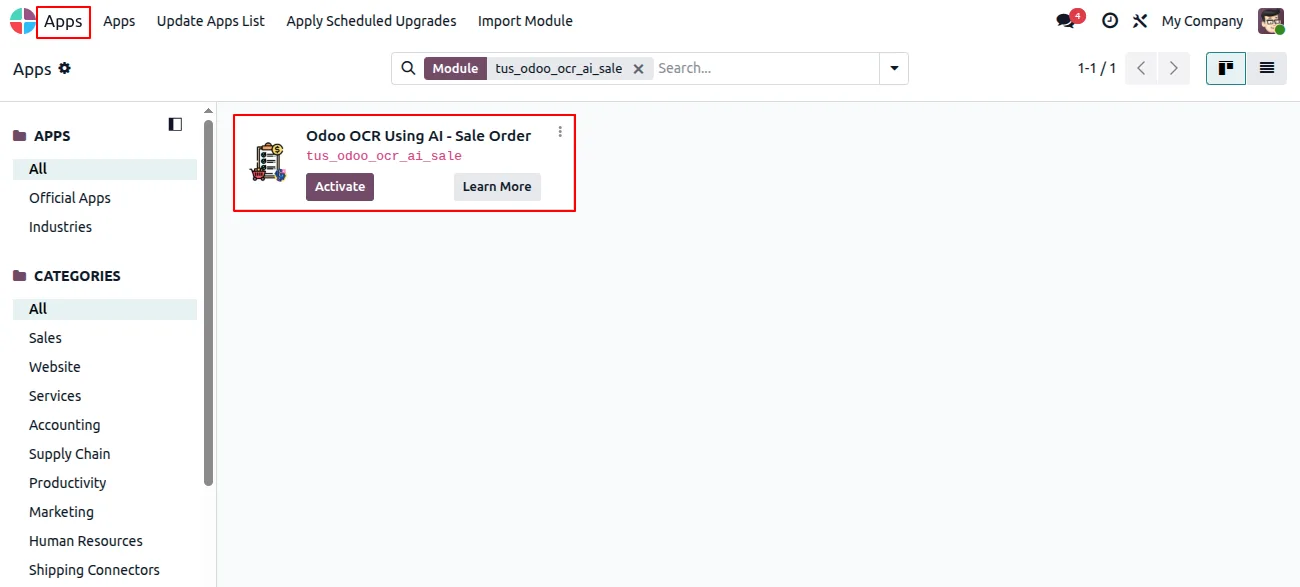
In Odoo, open Apps, remove the Apps filter, search for “Odoo OCR AI — Sale Orders”, and click Install. The shared Odoo OCR AI Base module installs with it.
-
Create an OCR AI account
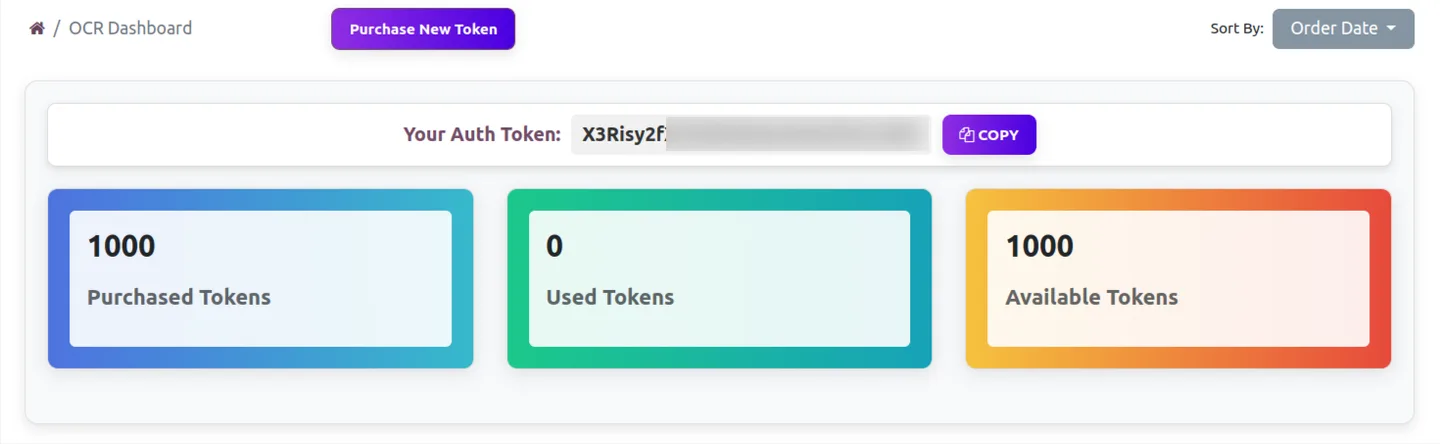
Register at ai.fynix.app and copy your authentication key from the OCR dashboard. Each company in a multi-company Odoo database can use its own token.
-
Buy OCR tokens
Purchase OCR tokens from ai.fynix.app/shop — 2 million tokens for $20 USD. Tokens are consumed per page as documents are processed; a typical order uses a few thousand tokens.

-
Configure the connection
Enable developer mode, go to Settings → OCR AI Integration, paste the company authentication token, and set the server URL to https://ai.fynix.app/tus_ocr_api.
-
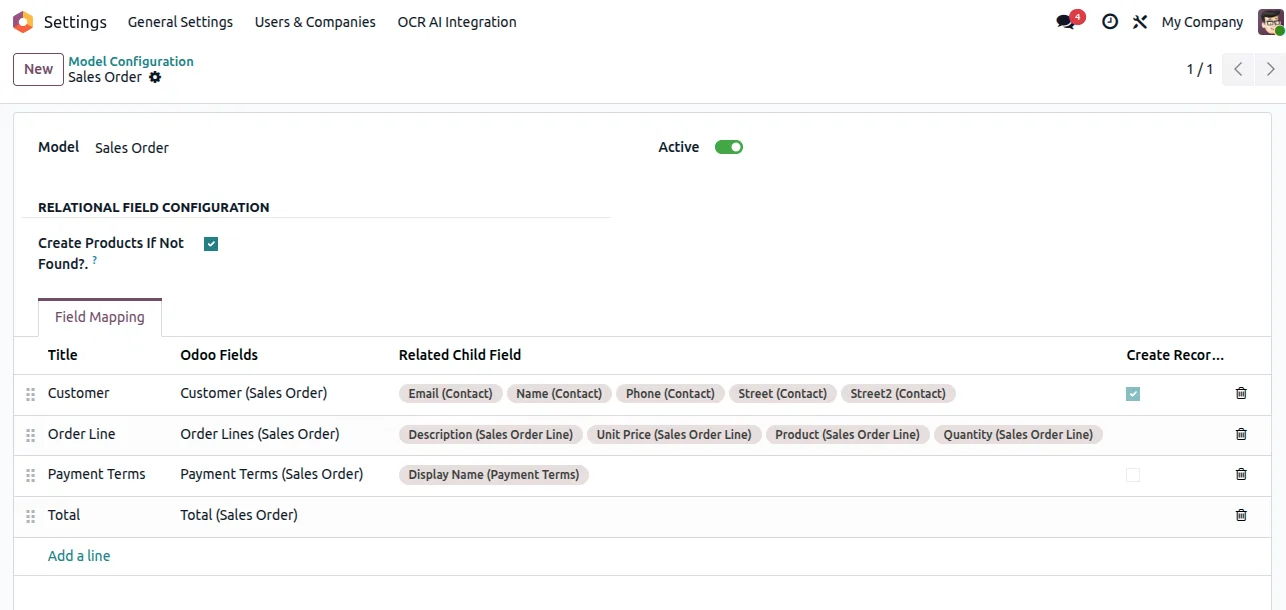
Map the sales order fields
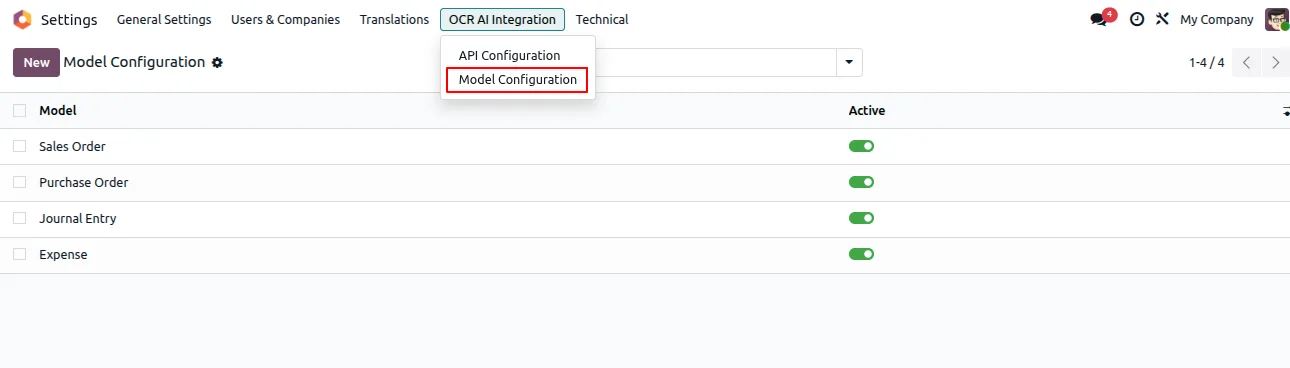
Open Settings → OCR AI Integration → Model Configuration and map the extracted fields onto the Sale Order model.
-
Upload and create
Upload a customer purchase order or order document as a PDF or image, let the AI read it, and create the Odoo sales order with a single click.
Deployment timeline
Standard deployment is 6–10 weeks: 1 week discovery and PO sampling, 2–3 weeks pipeline build, 2–3 weeks sandboxed testing, 1 week phased go-live. Existing OCR-Invoice pipelines accelerate sister deployments — many of the patterns are reusable.
Best for
Sales and order-management teams on Odoo 16, 17, 18, or 19 (Community or Enterprise) that want to remove manual customer-PO data entry without commissioning a custom OCR pipeline. Especially useful when customers send PDFs of purchase orders via email in many different layouts, since the AI is layout-agnostic and does not need per-customer templates. The free module + per-token extraction backend ($20 USD for 2 million tokens, fractions of a cent per document) means the unit economics work at low volume — no minimum order count is needed to justify the spend. Multi-company Odoo databases are supported via per-company OCR tokens.
Frequently asked questions
-
What's the difference between this and EDI?
EDI (Electronic Data Interchange) requires both parties to use compatible EDI gateways and standardized message formats. It's mature and reliable but requires customer adoption — and most small/mid-market customers don't have EDI. OCR AI handles whatever PDF the customer sends, no customer-side change required. Many clients use both: EDI for large customers who already support it, OCR AI for everyone else.
-
How accurate is line-item extraction?
First-pass accuracy is 88–94% on line items after the model is trained on your PO samples. Header data (customer, PO number, dates, totals) is typically 92–96%. Edits during the first 90 days feed back to the model; accuracy plateau is reached by month 3.
-
What happens when SKUs don't match our catalog?
Customer SKUs (often different from your internal SKUs) are mapped via cross-reference tables. We build the initial mapping during deployment. Unmapped SKUs flag the line for sales review with a search-suggest feature; once a sales rep maps the SKU, future POs from that customer auto-resolve.
-
Does it handle change orders and PO revisions?
Yes — when a PO references a previous PO number (e.g. 'change order against PO #12345'), the pipeline classifies as a change-order and updates the existing sales order rather than creating a duplicate. Change reasons (quantity, ship date, address) flagged for review.
-
What about customer-specific pricing?
Standard. Odoo's customer pricelists (contract pricing, volume breaks, special agreements) apply automatically when the sales order is created. Variance between the customer's listed price and your pricelist flags for sales review — sometimes the customer is wrong, sometimes the pricelist is out of date.
-
Can it handle RFQs that aren't yet POs?
Yes — RFQs are classified separately and create quotations (not sales orders) in Odoo. Quotations follow your standard quote-to-cash workflow: pricing review, approval, send to customer, conversion to SO when accepted.
-
What if the customer sends an EDI 850 instead of a PDF?
EDI 850 documents flow through the same pipeline (parsed natively rather than OCR'd) and create the same Odoo sales order. Mixed environments (some customers on EDI, some sending PDFs) work cleanly; downstream sales-order workflow is identical.
-
Implementation timeline?
6–10 weeks. Same shape as OCR Invoice: discovery, pipeline build, sandboxed testing, phased go-live. If you're also rolling out OCR Invoice, doing them together cuts ~2 weeks vs. sequential deployments because much of the underlying infrastructure is shared.