
Migration playbook
Migrate from SAP Business One to Odoo
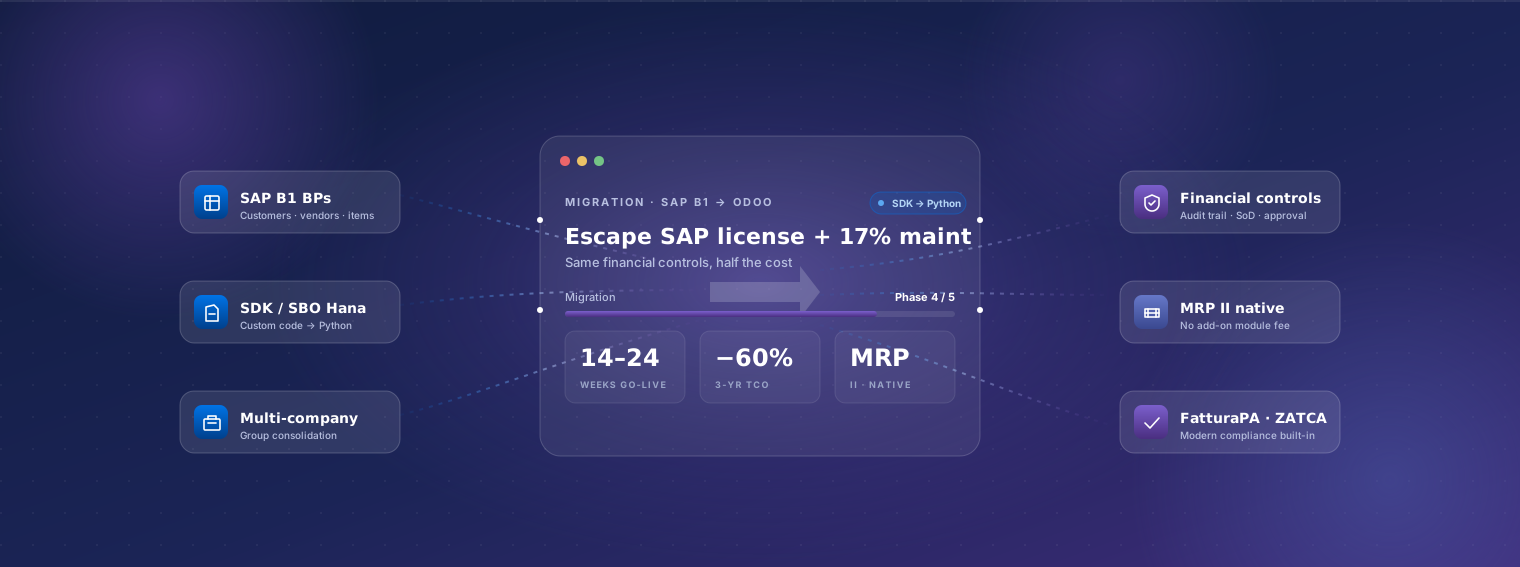
SAP Business One is genuinely capable mid-market ERP — and that's part of the problem. The per-named-user licensing, the 17% annual maintenance fee, the SDK lock-in for customisations, and the partner-dependent integration ecosystem add up to a Year-3 TCO that surprises most CFOs. Odoo replaces SAP B1 for businesses where the financial-controls depth isn't worth the cost premium. Here's the migration playbook, from a partner that has shipped it multiple times.
Last reviewed:
- Weeks end-to-end
- 14–24Weeks end-to-endtypical mid-market scope
- Fixed-price range
- $35–90kFixed-price rangeUSD, scope-dependent
- Weeks parallel run
- 3–4Weeks parallel runboth systems live
Why businesses migrate from SAP Business One to Odoo
-
License + maintenance TCO compounds
SAP B1 list pricing: USD 3,200 per Professional named user (one-time) + 17% annual maintenance + per-user SAP support. For 50 users: ~USD 160,000 initial license + ~USD 27,000/year maintenance + USD 30,000–60,000/year partner support. Odoo Enterprise Custom 50 users: ~USD 22,800/year all-in. Three-year delta: USD 200,000–300,000.
-
SDK customisation locked to partner
B1 customisations live in Sage SDK (.NET/Java) or SBO Hana — most customers don't have in-house SAP development capacity, so customisations are partner-built and partner-maintained. Changing partners is expensive because new partners often rebuild rather than reverse-engineer. Odoo's Python framework is broadly skilled in the market; partner switching is meaningfully cheaper.
-
Functional gaps outside core ERP
SAP B1 nails accounting, inventory, basic manufacturing, and procurement. CRM is light. E-commerce is third-party only. Marketing automation doesn't exist. Helpdesk is partner-add-on. Customers compensate with Salesforce + Marketo + Shopify + Zendesk + connectors. Odoo includes all of these in Enterprise.
-
Cloud / SaaS maturity
SAP B1's hosted offering (SAP Business One Cloud) was historically on-prem-first; cloud matured only in the past 2–3 years. Most B1 installations are still on customer servers or partner-hosted, with the operational overhead that implies. Odoo Online and Odoo.sh are mature cloud platforms.
-
User mobility and modern UX
SAP B1's desktop client (Windows-only) plus the web client (limited feature parity) make mobile work awkward. The B1 mobile app exists but lags the desktop. Odoo's web UI plus mobile app are consistent across devices and have feature parity in nearly every module.
-
Implementation cost imbalance
B1 mid-market implementations typically cost USD 40,000–120,000 from a SAP partner. Odoo equivalent: USD 25,000–60,000. The implementation-cost delta alone is often justification, before considering license fees.
-
Country-specific compliance lagging
SAP B1 country localisations exist (60+) but Sage-spec updates for new mandates (Saudi ZATCA Phase 2, France 2026 e-invoicing, EU CSRD reporting) often land in Odoo first because of release cadence. Customers in regulatory hotspots are sometimes paying for a slower-updating localisation.
-
Not on a path to S/4HANA
If your 3–5 year horizon doesn't include growing into S/4HANA (typical 1,000+ person enterprise), the optionality value of staying on SAP is negative. Mid-market businesses paying SAP B1 prices for SAP-tier optionality they won't use are over-paying.
What survives the migration
Plain-English breakdown of what we move, what we re-map, and what gets rebuilt in Odoo's framework rather than ported.
| Data category | Coverage | Detail |
|---|---|---|
| Business partners (customers + vendors) | Fully migrated | All BP master records migrated as Odoo contacts with addresses, contact persons, tax codes (VAT IDs, federal tax numbers), payment terms, credit limits, dunning configurations, opening balances. Hierarchical BP structures (parent–child) preserved. |
| Items (stock + non-stock + bill of materials) | Fully migrated | Item master with descriptions, item groups, costs, prices, tax codes, manufacturer details, item properties. Bills of materials (multi-level) migrate as Odoo BOMs preserving routing logic where present. |
| Chart of accounts | Partial / mapped | B1's chart of accounts (often deeply structured with sub-segments) re-mapped to Odoo's CoA with your auditor's input. Multi-segment account codes that exist in B1 become Odoo analytic-account hierarchies — usually a cleaner separation of concerns. |
| Opening balances (financial) | Fully migrated | GL account balances, AR, AP, fixed assets, loans, tax control accounts — reconciled to a specific cutover date. Auditor sign-off before cutover. B1's audit trail (transaction-level user / timestamp / before-and-after) is preserved in Odoo's audit log going forward. |
| Stock opening balances | Fully migrated | Opening stock by item by warehouse with cost. Costing method re-selected (FIFO, average, standard) per accounting policy. Lot/serial tracking continues — Odoo's lot/serial system is at least as deep as B1's batch management. |
| Transactional history (journals) | Partial / mapped | 1–3 years of AR invoices, AP invoices, payments, journal entries, manual GL postings migrated for historical reporting. Older history stays in B1 read-only (B1's license can downgrade to a 1-user read-only seat for archive). |
| Open documents (sales orders, purchase orders, deliveries) | Fully migrated | Open transactional documents — sales orders not yet delivered, POs not yet received, deliveries not yet invoiced — migrated with full state. The team picks up mid-flow rather than re-keying. |
| Banking and reconciliation | Partial / mapped | Bank account setup migrated. Outstanding (unreconciled) bank items migrated; historical reconciled items stay in B1. Bank feeds re-established in Odoo. |
| Manufacturing data (BOMs, routings, work centres) | Fully migrated | Multi-level BOMs, routings, work centres, and standard times migrate. SAP B1 Production module data becomes Odoo Manufacturing data. Discovery week validates the BOM count and complexity to plan the migration phase. |
| Multi-company structure | Fully migrated | Multi-company B1 deployments migrate cleanly. Each B1 company becomes an Odoo company; inter-company invoicing and consolidation re-implemented in Odoo's native multi-company features. |
| SDK custom developments | Rebuild in Odoo | SDK customisations (forms, validations, workflows) do not port. We inventory each during discovery, classify, and rebuild as Odoo customisations in Python — usually faster than expected because Odoo's defaults often cover what required heavy customisation in B1. |
| Crystal Reports / B1 Reports | Rebuild in Odoo | Crystal Reports and B1's native reports rebuilt as Odoo native reports, dashboards, or Spreadsheet views. Document each report's actual usage during discovery; rebuild only what's load-bearing — most B1 installations have 30+ reports of which 10 are actually used. |
| Approval procedures | Fully migrated | B1's approval procedures (purchase orders above threshold, manual journals above threshold, etc.) migrate to Odoo's approval workflows. Usually an opportunity to tighten approval logic that drifted over years. |
| Users and authorisations | Rebuild in Odoo | B1 license types (Professional, Limited, Indirect) become Odoo's role-based permissions. Migration is usually a chance to right-size user counts — B1's expensive licenses sometimes lead to shared accounts that Odoo's cheaper licensing makes unnecessary. |
Our phased approach
-
Discovery week
1 week, fixed-priceSenior consultant audits your B1 installation — version, modules, customisations, integrations, user count, BOM/routing complexity. Output: written migration plan + fixed-price quote. SDK customisation inventory is the longest line item.
-
Sandbox migration
6–10 weeksMigration scripts built against B1 SQL (or B1 HANA) databases, run into sandbox Odoo, reconciled to the cent. Your finance team validates partners, items, BOMs, balances, and representative transactions. Iterations expected — B1 data depth means edge cases surface during validation.
-
Odoo configuration in parallel
5–8 weeks (overlapping)Country localisation, e-invoicing (e.g. ZATCA, FatturaPA, France PPF), tax codes, approval workflows, multi-company setup, integrations. SDK customisations rebuilt in Python during this phase, tested in sandbox.
-
User training
2–3 weeksRole-based training in sandbox Odoo. B1 users typically have deep platform familiarity; the curve to Odoo is gentle but takes time. Recorded modules per role for ongoing reference. Test drives on production-like data — not toy demos.
-
Cutover weekend
1 long weekendB1 closes for new transactions Friday evening. Final migration runs Saturday and Sunday (longer than typical because of B1's data volume). Reconciliation Sunday/Monday with finance + auditor sign-off. Tuesday morning: team starts in Odoo.
-
Parallel-run period
3–4 weeksBoth Odoo and B1 accessible. New transactions in Odoo only; B1 read-only. We monitor every flow, fix anything that surfaces, validate at least one month-end close in Odoo before decommissioning B1.
-
Stabilisation
60 days post go-liveOn-call engineering for 60 days (longer than other migrations because B1 deployments are typically larger and edge cases take longer to surface). Weekly status. By day 60, finance has closed two month-ends in Odoo, manufacturing has run a full MRP cycle, and we transition to normal support.
Typical timeline
14–24 weeks end-to-end for typical mid-market SAP B1 migrations. Variables: (1) user count and data volume — 100-user B1 with 8 years of history takes 20+ weeks; (2) SDK customisation count — each non-trivial customisation adds 1–2 weeks; (3) manufacturing depth — multi-level BOMs and detailed routings add 2–4 weeks; (4) multi-entity complexity — each additional company adds 1–2 weeks. We commit to a specific timeline at the end of discovery.
Indicative cost
USD 35,000–90,000 fixed-price for end-to-end migration + Odoo go-live for typical mid-market scope. Discovery week: USD 4,000–6,000 fixed. Add USD 8,000–25,000 per substantial SDK customisation rebuild, USD 10,000–30,000 for substantial integration work. Compare to running SAP B1 Professional 50 users + maintenance + partner support: typically USD 80,000–140,000/year. Three-year TCO advantage to Odoo: USD 200,000–400,000.
Risks and mitigations
-
Risk: SDK customisation rebuild scope
Mitigation: SDK customisations are the longest-tail risk. Discovery week explicitly inventories each customisation: what it does, who uses it, what business outcome it produces. Most customisations end up classified as 'Odoo default covers this' (40–60%) or 'rebuild as 50% smaller Python module' (30–40%). Pure ports are rare.
-
Risk: Hidden SBO Hana dependencies
Mitigation: B1 HANA installations sometimes have Hana-specific stored procedures or calculation views invoked by integrations. We do a HANA dependency audit during discovery; surface every non-standard object before sandbox phase. Resolves the 'integration X mysteriously broken' day-of-cutover scenario.
-
Risk: Multi-company inter-company elimination logic
Mitigation: B1 multi-company customers often have group reporting structures with specific elimination rules. We design Odoo's multi-company hierarchy and elimination logic during configuration phase with your finance team; validate against historical B1 consolidations before cutover.
-
Risk: Auditor reluctance on cutover timing
Mitigation: SAP B1 customers usually have established audit relationships. Discovery week includes a call with your auditor on cutover timing — Q1 post year-end is preferred, mid-quarter is workable, Q4 is risky. We've migrated B1 customers audited by Big 4 and large mid-tier firms without findings.
-
Risk: Manufacturing cutover during active production
Mitigation: Manufacturers can't shut down for cutover weekend. We design a phased manufacturing cutover — open work orders complete in B1, new work orders start in Odoo from a specific date. Parallel period covers the overlap. Production team's input on timing is critical.
-
Risk: Approval chain continuity
Mitigation: B1 approval procedures often encode multi-level company hierarchy. We design Odoo's approval workflows in discovery with your CFO; map each B1 approval rule explicitly. Pending B1 approvals at cutover are migrated as Odoo approvals in flight.
-
Risk: Crystal Reports nobody documented
Mitigation: Standard B1 installation has 30–80 Crystal Reports. Most aren't used regularly but somebody uses each one. We require a report inventory during discovery: per role, which reports run weekly. Anything load-bearing rebuilt as Odoo report — usually 10–15 reports, not 30–80.
-
Risk: Sage SAP-specific integrations (Boyum, B1iF, B1if)
Mitigation: Third-party B1 add-ons (Boyum B1UP, B1 Print and Delivery, etc.) audited during discovery. Most have direct Odoo equivalents; some are replaced with simpler custom solutions. Boyum scripting specifically doesn't port — those workflows get rebuilt.
Who should migrate
Mid-market businesses (50–500 users) on SAP Business One Professional, where the cost-to-value ratio has tipped.
- cost-sensitive manufacturers comfortable that Odoo's MRP II matches their needs
- multi-entity groups where multi-company consolidation is core
- businesses outside the SAP partner-deep regions (DACH, Italy) where the SAP ecosystem advantage is less relevant
- businesses without a 3–5 year path to S/4HANA. Not a fit: businesses with hard financial-controls regulatory requirements where SAP's audit framework is contractually required, or businesses planning to grow into S/4HANA
Frequently asked questions
-
Will I lose financial-controls depth moving from SAP B1 to Odoo?
Some — yes. SAP B1's audit trails, segregation-of-duties enforcement, and approval framework are deeper than Odoo's by default. For most mid-market businesses (50–500 employees) without specific regulatory requirements, Odoo's controls are sufficient. For highly regulated finance (banks, listed companies subject to SOX, etc.), B1 — or moving up to S/4HANA — is the safer choice. Discovery week assesses this honestly.
-
What about the SAP partner ecosystem we've built relationships with?
Legitimate concern — the SAP partner ecosystem is deep, especially in DACH, Italy, and tier-2 manufacturing. After migration you'll need an Odoo partner relationship, not a SAP one. TechUltra is an Odoo Gold Partner with an Ahmedabad office plus partner firms in the UK, South Africa, Italy, and Peru. We've taken over from SAP B1 partners in multiple regions; the partner-side transition is smooth.
-
How do migration costs compare to the SAP B1 'just keep paying maintenance' option?
Maintenance is ~17% of license value annually, so for a USD 160,000 50-user B1 license, that's USD 27,000/year, indefinitely. Add USD 30,000–60,000/year partner support. Migration to Odoo is a one-time USD 35,000–90,000 cost; payback typically 12–18 months from the saved license + maintenance + support spend.
-
Will Odoo handle our country localisation (e.g. Italy FatturaPA, Saudi ZATCA, France e-invoicing)?
Yes — and often with better recent coverage. Odoo's release cadence means new mandates (Saudi ZATCA Phase 2, France 2026 PPF, Germany GoBD updates) typically land in Odoo first. Italy FatturaPA, UK MTD VAT, India GST, Mexico CFDI, EU EN 16931 (Peppol) all supported natively in Odoo Enterprise.
-
Can we migrate from SAP B1 HANA specifically?
Yes — B1 SQL or B1 HANA, both. HANA installations require an extra HANA dependency audit during discovery because integrations often invoke Hana-specific objects (stored procedures, calc views). We handle this routinely.
-
How does Odoo's manufacturing compare to SAP B1 Production?
For mid-market (most B1 manufacturing customers), comparable. SAP B1 edges Odoo for complex MRP III scenarios (multi-level forecasting, advanced ATP/CTP) and mature MES integrations in DACH-style discrete manufacturing. Odoo has caught up significantly in versions 17–19. Discovery week assesses whether your specific manufacturing needs fall in the 'either works' or 'B1 still better' zone.
-
What's the migration approach for multi-entity B1 groups?
We typically migrate the simplest entity first (smallest data, simplest customisations, lowest operational risk), then larger entities in subsequent waves. Each entity is its own scope; group consolidation re-implemented in Odoo's multi-company setup once 2+ entities are live. Wave-based approach takes longer overall (5–8 months for 4–5 entities) but reduces risk per cutover.
-
What about open service contracts and customer service histories?
B1's service module data (contracts, service calls, equipment cards) migrates to Odoo Helpdesk + Maintenance + Field Service modules. Equipment serial-number history and contract terms preserved. Open service calls migrate as in-flight Odoo tickets.
-
Will our customers see continuity in document formats?
Yes. We re-create your B1 invoice, statement, delivery note, and PO templates as Odoo reports during migration. The first Odoo-issued document to a customer is indistinguishable from a B1 document except for the system that produced it.
-
Does Odoo support our country's e-invoicing mandate?
Probably — list of natively supported regimes: India GST (IRN + e-way bill), Italy FatturaPA, Saudi Arabia ZATCA Phase 2, Mexico CFDI 4.0, France 2026 e-invoicing (PPF), Germany GoBD, EU EN 16931 / Peppol BIS Billing 3.0, UK MTD VAT, Australia BAS, South Africa SARS. If your specific country isn't in this list, ask — we'll check Odoo's current localisation coverage.
-
How long does the parallel run need to be for a complex B1 migration?
3–4 weeks minimum. Week 1 proves operational flows under load. Week 2 catches month-end. Week 3 catches quarterly close or quarterly tax filing if applicable. Week 4 is cushion. For 4-entity multi-company migrations or businesses with quarterly cycles, we extend to 6–8 weeks. Don't compress below 3 weeks.
-
What's the first step?
A 45-minute scoping call. Bring: B1 version, user count, module list, integration partners, top three reasons you're considering moving. We'll tell you whether discovery week is the right next step and what the realistic project size looks like.