
Migration playbook
Migrate from NetSuite to Odoo
NetSuite is well-built mid-market ERP — and its renewal pricing is well-known for catching customers off-guard. Year 3 renewals routinely double Year 1 spend; professional services contracts are open-ended; SuiteScript customisations lock you in. For businesses where NetSuite's functional depth isn't worth the Oracle premium, Odoo is the natural alternative. Here's how the migration actually works, from a partner who has shipped it for businesses leaving NetSuite specifically because of pricing.
Last reviewed:
- Weeks end-to-end
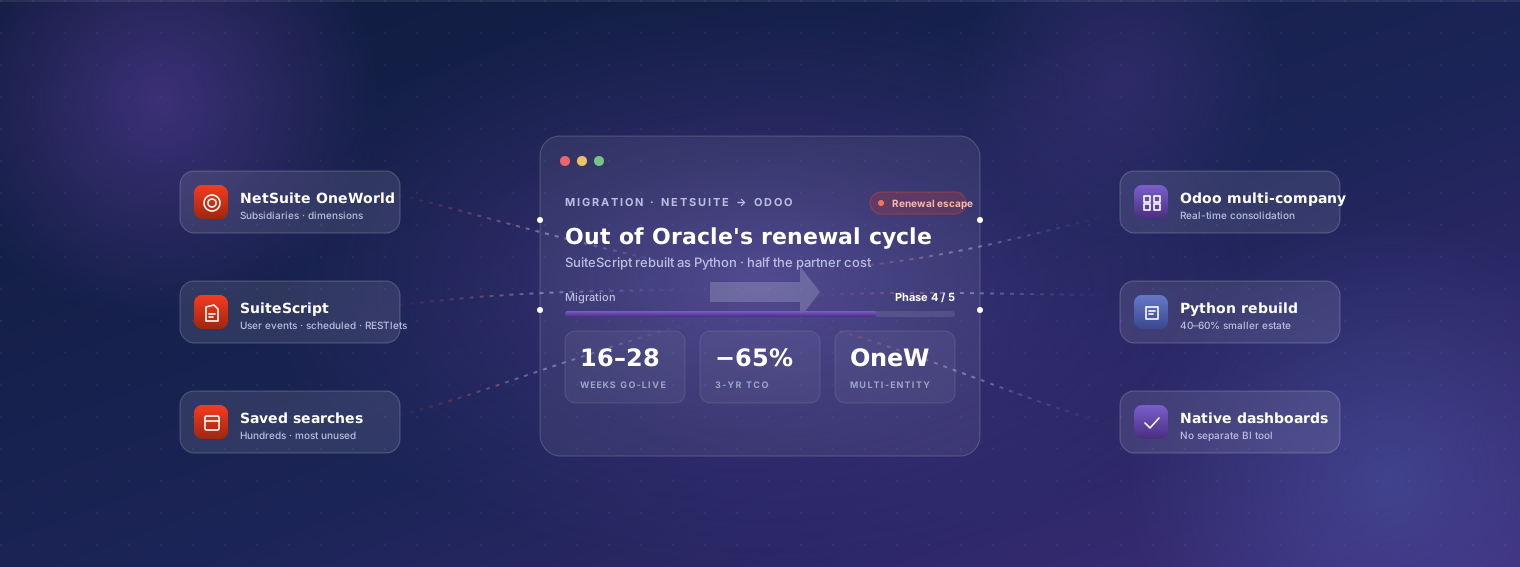
- 16–28Weeks end-to-end+2–4 wks per subsidiary
- Fixed-price range
- $40–120kFixed-price rangeUSD, scope-dependent
- Weeks parallel run
- 4Weeks parallel runboth systems live
Why businesses migrate from NetSuite to Odoo
-
Renewal pricing increases
NetSuite is famous for aggressive renewal pricing — 15–30% year-on-year increases are common, sometimes higher. Customers who locked in attractive Year-1 pricing often see their renewal bill triple by Year 3. Odoo's per-user pricing is published list and stable; multi-year prepayment discounts are modest but available.
-
Per-module pricing compounding
NetSuite's modular pricing means each capability beyond core (Advanced Inventory, Advanced Manufacturing, Demand Planning, OneWorld, SuiteCommerce, etc.) carries its own per-user-per-month fee. By the time a mid-market business has what it needs, the bill is USD 80,000–250,000/year. Odoo Enterprise Custom is one all-in number.
-
Professional services contracts going long
Many NetSuite implementations end up in extended professional services engagements — original go-live followed by 12–24 months of partner work that doesn't seem to end. Customers feel locked in because switching partners means re-learning the SuiteScript estate. Odoo's Python-based customisation has a much wider partner pool.
-
SuiteScript customisation lock-in
Heavy SuiteScript customisations (user event scripts, scheduled scripts, RESTlets, workflows) accumulate over years. Each customisation feels worth more than it cost to build because of switching cost. Migration to Odoo rewrites in Python — the framework is broadly skilled, the costs are visible.
-
Functional ceilings on lower NetSuite editions
NetSuite Limited or NetSuite Standard customers eventually hit functional limits (no advanced inventory, no manufacturing, no multi-subsidiary). The upgrade to OneWorld or to higher editions is a meaningful cost jump. Odoo Enterprise Custom includes all functional modules at one per-user price.
-
Sub-1000-user mid-market squeeze
NetSuite is positioned for upper mid-market and lower enterprise. Sub-300-user businesses often pay enterprise prices without getting enterprise-tier functional value. Odoo is more cost-aligned for businesses in the 50–500 user range — same functional breadth, half to a third of the TCO.
-
Multi-currency and multi-subsidiary at smaller scale
NetSuite OneWorld is excellent at multi-subsidiary multi-currency but costs accordingly. Businesses with 2–4 entities sometimes don't need OneWorld's depth and can run Odoo's native multi-company at meaningfully lower cost.
-
SuiteCommerce vs unified e-commerce
SuiteCommerce is a separate module and historically maintained at NetSuite's release cadence — which can lag Shopify / Magento etc. on modern UX. Many NetSuite customers use SuiteCommerce reluctantly. Odoo eCommerce is native to the ERP database with no sync layer.
What survives the migration
Plain-English breakdown of what we move, what we re-map, and what gets rebuilt in Odoo's framework rather than ported.
| Data category | Coverage | Detail |
|---|---|---|
| Customers | Fully migrated | All NetSuite customer records migrated as Odoo contacts with addresses, contacts, tax IDs, payment terms, credit limits, subsidiaries (multi-company assignment), opening AR balances. Hierarchical customer relationships preserved. |
| Vendors | Fully migrated | Vendor records with banking, payment terms, 1099 status (US), tax registrations, subsidiary assignments, opening AP balances. Vendor categories migrate to Odoo's contact tagging. |
| Items (inventory, non-inventory, service) | Fully migrated | Item master with SKUs, descriptions, prices, costs (including landed cost), tax codes, units of measure, item categories. Matrix items (NetSuite's variant model) migrate to Odoo's product variants. |
| Chart of accounts | Partial / mapped | NetSuite's multi-dimensional CoA (Account + Subsidiary + Class + Department + Location + Custom Segments) maps to Odoo's CoA + multi-company + analytic accounting. Usually a chance to simplify segmentation that grew organically over years. |
| Opening balances (financial) | Fully migrated | GL balances per subsidiary, AR, AP, intercompany balances, fixed assets, accumulated depreciation — reconciled to cutover date. Multi-subsidiary opening balance reconciliation is the longest reconciliation task for OneWorld customers. |
| Stock opening balances | Fully migrated | Opening stock by item by location with cost. NetSuite's standard cost / average cost / FIFO costing methods translate cleanly. Bin / location structure preserved. |
| Transactional history (1–3 years) | Partial / mapped | Sales invoices, vendor bills, payments, receipts, journal entries migrated for historical reporting. Older history stays in NetSuite read-only (NetSuite licenses can downgrade to a Reader account for archive — note Oracle still charges, but at lower rates). |
| Open transactions (SOs, POs, deliveries) | Fully migrated | Open sales orders, purchase orders, item receipts, item fulfillments, return authorizations — full state. Team picks up mid-flow. |
| Bills of materials (assemblies) | Fully migrated | NetSuite Advanced Manufacturing assembly items with multi-level BOMs and routings migrate to Odoo BOMs. Work centres and standard times preserved. Manufacturing-on-NetSuite customers often welcome Odoo's manufacturing UX — easier to use. |
| Subsidiaries / multi-company structure | Fully migrated | NetSuite OneWorld subsidiaries become Odoo companies. Inter-subsidiary transactions, eliminations, consolidation re-implemented in Odoo's multi-company native features. |
| Saved searches and reports | Rebuild in Odoo | NetSuite saved searches don't port. We inventory each saved search and report used in production during discovery; rebuild as Odoo native reports, dashboards, or Spreadsheet views. Output is typically faster and more flexible than NetSuite's saved-search UI. |
| SuiteScript customisations | Rebuild in Odoo | SuiteScript (user event scripts, scheduled scripts, RESTlets, workflows, Suitelets) doesn't port. We inventory each script during discovery: purpose, trigger, business outcome. Classify as 'Odoo default covers this' (40–60%), 'rebuild as Python customisation' (30–40%), or 'no longer needed' (10–20%). Rebuilds are typically smaller than originals. |
| SuiteFlow workflows | Rebuild in Odoo | SuiteFlow workflows rebuilt as Odoo automated actions or server actions — usually with cleaner logic because Odoo's automation primitives are more focused. |
| SuiteCommerce sites (if applicable) | Rebuild in Odoo | SuiteCommerce migrated to Odoo eCommerce or to a separate Shopify/Magento store synced with Odoo. Most NetSuite customers welcome this migration — SuiteCommerce sites are often the operationally fragile piece of the NetSuite stack. |
| Users and roles | Rebuild in Odoo | NetSuite roles (often 30+ custom roles in a mature installation) re-created in Odoo's role-based permissions. Migration is usually a chance to consolidate role drift. |
Our phased approach
-
Discovery 2 weeks
2 weeks, fixed-priceSenior consultant + technical lead audit NetSuite — subsidiaries, modules, SuiteScript estate, saved searches, integrations. Discovery is 2 weeks (not 1) because NetSuite installations have more breadth to inventory. Output: written migration plan + fixed-price quote + SuiteScript rebuild list.
-
Sandbox migration
8–14 weeksMigration scripts built against NetSuite REST API / SuiteTalk SOAP, run into sandbox Odoo, reconciled to the cent across all subsidiaries. Your finance team validates customers, items, balances per subsidiary, BOMs, and representative transactions. Iterations expected with NetSuite's data depth.
-
Odoo configuration in parallel
6–10 weeks (overlapping)Country localisations per subsidiary (US sales tax via Avalara connector, UK MTD VAT, EU VAT, India GST, etc.). Multi-subsidiary setup. SuiteScript customisations rebuilt in Python. Integrations migrated from NetSuite connectors to Odoo equivalents.
-
User training
3–4 weeksRole-based training in sandbox Odoo per subsidiary. NetSuite users often have years of platform familiarity; we plan for a deliberate transition with hands-on practice on real workflows, not slides.
-
Cutover (long weekend or planned downtime window)
1 long weekend, sometimes scheduled downtimeNetSuite closes for new transactions Friday evening. Final migration runs Saturday and Sunday with all subsidiaries reconciled. Monday/Tuesday: team starts in Odoo. For high-volume e-commerce / international businesses, we may schedule a longer planned downtime window to ensure reconciliation completes.
-
Parallel-run period
4 weeksBoth Odoo and NetSuite accessible. New transactions in Odoo only; NetSuite read-only. We monitor every flow, fix anything that surfaces, validate at least one month-end close and one inter-subsidiary settlement before decommissioning NetSuite.
-
Stabilisation
90 days post go-liveOn-call engineering for 90 days (longer than other migrations because NetSuite deployments are larger and edge cases can surface across the quarter). Weekly status reviews. Quarterly close from Odoo before formal end-of-support transition.
Typical timeline
16–28 weeks end-to-end. Variables: (1) subsidiary count — each OneWorld subsidiary adds 2–4 weeks; (2) SuiteScript estate size — large estates (50+ scripts) add 4–8 weeks; (3) integration partners — each substantial third-party integration adds 2–4 weeks; (4) industry compliance (SOX, FDA, etc.) — adds 2–4 weeks of additional validation. Discovery week confirms timeline against your specific scope.
Indicative cost
USD 40,000–120,000 fixed-price for end-to-end migration + Odoo go-live for typical mid-market scope. Discovery 2 weeks: USD 6,000–10,000 fixed, deductible. Add USD 15,000–40,000 for substantial SuiteScript rebuild, USD 20,000–50,000 for multi-subsidiary (OneWorld). Compare to NetSuite ongoing: USD 80,000–250,000/year subscriptions + USD 40,000–80,000/year professional services. Three-year TCO advantage to Odoo: USD 250,000–700,000 typical.
Risks and mitigations
-
Risk: SuiteScript estate larger than realised
Mitigation: Customers often under-estimate their SuiteScript footprint because scripts accumulated over years. Discovery 2 weeks explicitly catalogs the entire estate via NetSuite's SuiteScript Admin tools; no surprises after that.
-
Risk: OneWorld inter-subsidiary balance reconciliation
Mitigation: Multi-subsidiary balance reconciliation is the longest-running task per cutover. We sandbox-test the cross-subsidiary close 2–3 times before live cutover. Reconciliation discrepancies under USD 100 written off; anything higher investigated. Auditor sign-off required on cutover balances.
-
Risk: NetSuite contract renewal pressure during migration
Mitigation: Oracle's renewal cycle creates pressure mid-migration — auto-renewal terms in your NetSuite contract may auto-bill before you cut over. Discovery includes a contract audit; we plan migration timing to align with the renewal window so you don't pay for a second year of NetSuite unnecessarily.
-
Risk: Avalara / TaxJar integration continuity
Mitigation: US sales-tax customers usually integrate NetSuite with Avalara or TaxJar. We migrate the integration to the Odoo Avalara / TaxJar connector — credentials transfer cleanly, calculation behaviour validated against historical NetSuite invoices in sandbox.
-
Risk: Bundle installations (SuiteApps) lost in migration
Mitigation: SuiteApps (NetSuite's third-party app ecosystem) don't port. Each SuiteApp audited during discovery: most have direct Odoo equivalents (often cheaper / better-maintained), some are replaced with simpler custom solutions. Rare cases require a custom build for an industry-specific SuiteApp.
-
Risk: SuiteCommerce migration complexity
Mitigation: SuiteCommerce sites require their own migration sub-project. Discovery week assesses: how much of the site is bespoke front-end vs standard SuiteCommerce templates; product catalog state; existing customers and order history. Output: dedicated SuiteCommerce migration scope, typically 6–10 weeks within the broader project.
-
Risk: Saved-search dependencies that nobody documented
Mitigation: NetSuite mature installations have hundreds of saved searches. Many are dependencies for SuiteScripts, integration filters, or dashboards. We require an audit during discovery: per role, which saved searches actually drive operational work. Rebuild only what's load-bearing.
-
Risk: Approval workflow continuity
Mitigation: Custom approval flows in SuiteFlow rebuilt in Odoo's approval framework. Pending approvals at cutover are migrated as Odoo approvals in flight. We test approval routing during sandbox phase with real users from each approval role.
Who should migrate
Mid-market businesses (50–500 users) on NetSuite — particularly: cost-sensitive customers facing renewal pressure; businesses with manageable (under 30) SuiteScript customisations; multi-subsidiary groups in 2–4 entities (where OneWorld is overkill); industry verticals where NetSuite's industry-specific SuiteApps are replaceable. Not a fit: businesses planning to grow into NetSuite's upper-enterprise range (1,000+ users with 10+ subsidiaries), businesses subject to specific regulatory frameworks where NetSuite's audit capabilities are contractually required.
Frequently asked questions
-
How aggressive are NetSuite renewal increases really?
Anecdotal data from migrating customers: 10–30% year-on-year increases are typical. Customers who locked in a 'great' Year-1 deal often see double or triple by Year 3. Some Oracle renewal negotiations have flat-lined at the existing price; many have not. Treat any 'aggressive Year-1 discount' as a price you'll regret in Year 3.
-
Does Odoo handle multi-subsidiary OneWorld scenarios?
Yes — Odoo's multi-company is native and capable up to roughly 20 entities in one instance comfortably. Real-time consolidation, inter-company invoicing, multi-currency, multi-country localisation per entity all work. Beyond 20 entities or with complex legal-structure consolidation, we'd evaluate alternative architectures.
-
What about NetSuite's industry-specific SuiteApps (Wholesale Distribution, Manufacturing, Software, etc.)?
Most of NetSuite's industry SuiteApps are configurations of base NetSuite, not different products. Odoo's equivalent industry coverage is via standard modules + configuration, similar approach. Discovery week assesses which SuiteApp features your business actually relies on; we configure Odoo's equivalents during migration.
-
How do SuiteScript rebuilds compare in time and cost to the originals?
Most rebuilds are smaller than the originals because Odoo's defaults cover what required SuiteScript. Example: NetSuite-style custom AP approval workflow takes 80–120 hours in SuiteScript; Odoo's native approval framework covers 70% of that out of the box, with the remainder being 20–40 hours of customisation. Total estate often shrinks by 40–60% in the migration.
-
Will my financial reporting be at least as good in Odoo?
Yes — Odoo's financial reports (P&L, balance sheet, cash flow, GL detail) are mature and comparable to NetSuite's standard reports. Multi-dimensional analytics (NetSuite's saved searches plus reports) rebuilt as Odoo native dashboards + Spreadsheet views. Custom multi-currency consolidation reports rebuild during migration.
-
What about SuiteAnalytics — NetSuite's BI?
Standard SuiteAnalytics workbooks rebuild as Odoo dashboards + Spreadsheet views during migration. Customers using advanced SuiteAnalytics often pair Odoo with a BI tool (Metabase, Looker, Power BI) for the analytics layer — comparable to NetSuite stack but at lower combined cost.
-
Can we migrate our SuiteCommerce site to Odoo eCommerce?
Yes — but it's its own sub-project. SuiteCommerce sites with bespoke front-end work require front-end rebuild in Odoo's eCommerce framework (or migration to Shopify/Magento with Odoo as the back-end). Discovery week scopes SuiteCommerce migration separately.
-
What's the right time to migrate relative to NetSuite renewal?
Start discovery 6 months before NetSuite renewal date. Migration takes 16–28 weeks. Cutover 1–2 months before renewal. Cancel NetSuite renewal at the appropriate notice period. The 6-month lead time avoids paying for a second year of NetSuite while still in migration.
-
Is Odoo really 'mid-market enough' compared to NetSuite?
For businesses under 500 users with up to 5 subsidiaries: yes, comparable functional coverage. For businesses at 1,000+ users with 10+ subsidiaries, complex inter-co eliminations, and SOX-compliance requirements, NetSuite still has an edge — but those businesses are usually paying enough to justify it. The 'mid-market squeeze' is sub-500-user businesses paying NetSuite enterprise prices.
-
How much partner work do we need ongoing vs with NetSuite?
Comparable in hours but cheaper per hour. NetSuite partners typically bill USD 150–280/hour. Odoo Gold Partners typically USD 80–180/hour depending on region. For a 50-user mid-market business: USD 30,000–60,000/year partner support is typical for either platform; the unit cost difference shows up as more hours or more capacity per dollar with Odoo.
-
Will our auditor be comfortable with the migration?
Yes — we plan cutover timing with your audit firm. Most US Big 4 auditors have Odoo familiarity at this point. Mid-tier audit firms occasionally need a quick walkthrough of Odoo's audit trails and segregation-of-duties enforcement; we provide that as part of the migration with your audit team.
-
What's the first step?
A 45-minute call. Bring: NetSuite edition (Limited / Standard / OneWorld), user count, subsidiary count, top 3 modules in use, and the SuiteScript estate size (rough — 10? 50? 200 scripts?). We'll tell you whether discovery week is worth scheduling.