
Odoo Recovery
Odoo Rescue & Partner Switch
Stuck with an Odoo implementation that doesn't work the way it was sold? We take over from the previous partner without ripping out what's already there. Audit, stabilise, fix the worst pain in 30 days, and a credible plan to get the rest right — fixed-price, no finger-pointing.
Last reviewed:
What it is
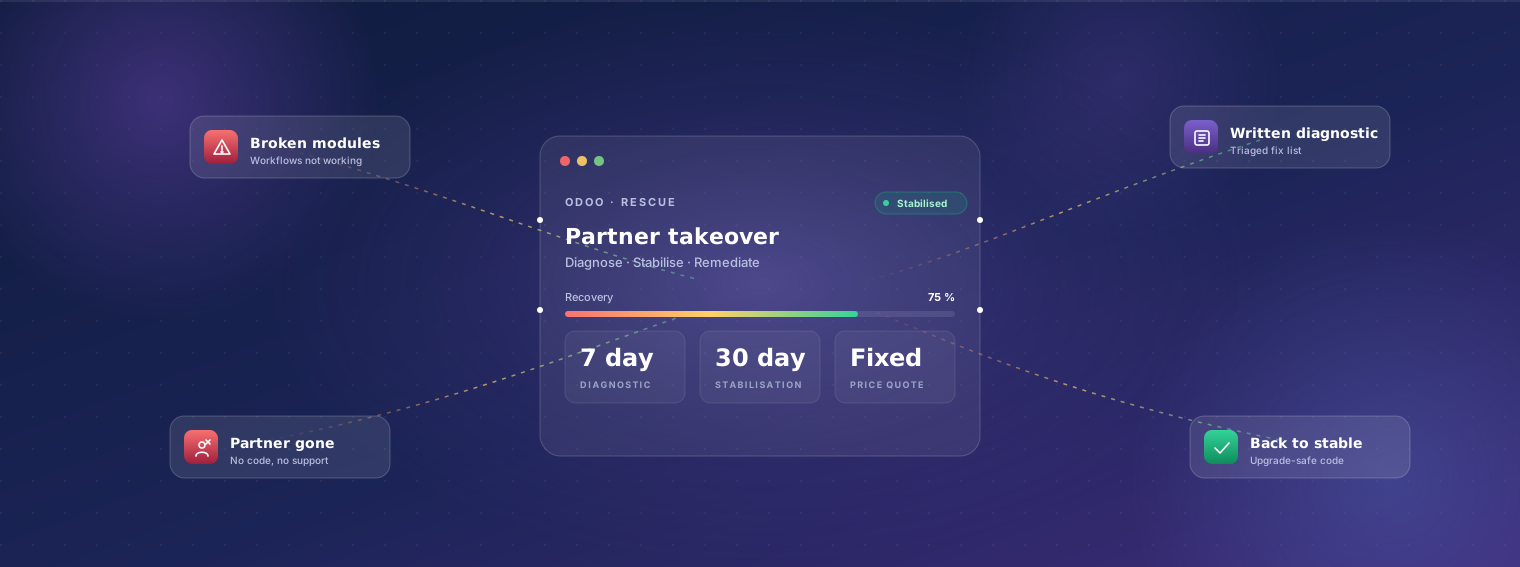
Odoo Rescue is a structured engagement for businesses already on Odoo whose implementation isn't delivering — broken data, half-finished customizations, missing functional coverage, ballooning support tickets, or a previous partner that's stopped responding. Unlike a fresh implementation, a rescue starts from where you are: we don't tear out working pieces, we don't re-migrate stable data, we don't double-bill discovery you've already paid for. We diagnose what's actually broken, classify each issue as 'stabilise now / fix this quarter / accept and document,' and ship the fixes in priority order under a fixed-scope statement of work.
Why it matters
An estimated 30–40% of Odoo implementations underperform in the first 12 months — usually because the original partner under-scoped, the business under-resourced, or the version chosen was too aggressive. The default response is to keep paying the same partner for incremental fixes, or to consider a full re-implementation. Both are expensive and slow. A rescue costs a fraction of either: the data is mostly fine, the configuration is mostly fine, the codebase has 20% of the problems and 80% of the value. The right move is targeted remediation by a partner who's seen this before, not another full rebuild.
Features
| Capability | What it does |
|---|---|
| 7-day written diagnostic | Senior consultant spends one week inside your Odoo instance, your previous partner's repo (if accessible), and on calls with your team. Output: a written report covering version, module state, customization quality, data integrity, top operational blockers, and a triaged fix list. |
| 30-day stabilisation sprint | We fix the three operational blockers that are costing your team the most hours per week — usually broken automations, missing reports, or workflows that force off-system workarounds. Goal: your team stops dreading Odoo within 30 days. |
| Fixed-price remediation roadmap | After the diagnostic, you get a fixed-price quote for the full remediation — not a T&M open-ended engagement. Every line item has a scope statement, an acceptance test, and a calendar week. No surprise invoices. |
| No-blame handover | We don't trash the previous partner in writing or in client meetings. The diagnostic identifies issues, not villains. This matters because rescue clients often have ongoing contracts, NDAs, or working relationships with the previous partner that need to wind down cleanly. |
| Upgrade-safe rework | Customizations rewritten using upgrade-safe patterns so the next Odoo version upgrade doesn't re-break what we just fixed. We treat every fix as long-term code, not patch-on-patch. |
| Data integrity recovery | When the diagnostic uncovers data problems — duplicated customers, mis-mapped tax codes, broken stock moves, orphaned journal entries — we run targeted clean-up scripts with audit trails so finance can sign off, not just trust us. |
| Module scope-back where appropriate | Sometimes the previous partner over-installed. A rescue may include turning OFF modules that aren't load-bearing, removing customizations that nobody uses, and simplifying back to defaults. Less code is often the right answer. |
| Phased re-training | User adoption usually collapses alongside a bad implementation. We re-train by role (AR, AP, warehouse, sales) on the fixed workflows, with short recorded modules your team can re-watch. No dry classroom sessions. |
How it works
-
First call (45 minutes, free)
Walk us through what's not working. We ask the questions that distinguish a rescue from a re-implementation — current version, who built it, how many users, where the pain is sharpest. If it's not a rescue, we'll say so up front.
-
Diagnostic week
Fixed price, fixed scope, 7 calendar days. We need read access to your Odoo instance, a list of your team's top pain points, and 60 minutes each from 3–5 key users. Output: written diagnostic + remediation roadmap with fixed prices.
-
Stabilisation sprint
30 days. Three operational blockers fixed, deployed, validated. Daily standup; weekly written status; end-of-sprint demo. Your team should feel measurable relief by day 30.
-
Remediation phases
The rest of the roadmap in 2–4 week phases, each with a written scope and an acceptance test. You sign off at the end of each phase before the next starts. No rolling scope creep.
-
Stability period
30 days post-remediation. We're on-call, watching the system, fixing anything that surfaces, with no per-ticket billing. The goal is to leave you confident, not dependent.
-
Ongoing support handover
By the end of the stability period, you decide: take it in-house, sign a maintenance retainer with us, or stay with a previous partner now that the system is stable. We're indifferent — the rescue is done.
Deployment timeline
Diagnostic: 7 calendar days. Stabilisation sprint: 30 days. Full remediation (after stabilisation): typically 6–12 weeks depending on the depth of issues. Most rescues are fully stable inside 16 weeks; the worst cases (botched migrations, large custom codebases) can run 20–24 weeks. We give you a credible end date inside the first two weeks — not at the end.
Best for
Businesses already running Odoo (Community or Enterprise, any version from 14 onwards) where the implementation is underperforming. Especially: companies whose original partner has disappeared, gone bankrupt, or become non-responsive; companies whose previous partner did a v1 implementation but doesn't have the depth for the harder modules (manufacturing, e-invoicing, multi-entity); companies considering a full re-implementation as a last resort but wanting to try targeted fixes first. Not a fit if you've outgrown Odoo entirely or if the original choice of Odoo was structurally wrong — we'll say so honestly during the first call.
Frequently asked questions
-
How is a rescue different from regular Odoo support?
Regular support is reactive — tickets in, fixes out, billed by the hour or by the retainer. A rescue is structured and outcome-led: written diagnostic, fixed-price stabilisation, fixed-price remediation, defined end date. You're not signing up for an open-ended support relationship; you're signing up to get back to stable, after which you decide on ongoing support separately.
-
Will you trash-talk our previous partner?
No. The diagnostic identifies issues, not villains. We've seen partners do their best with bad scope; we've seen clients change scope mid-build and blame the partner; we've seen genuine partner failures. Either way, writing 'partner did a bad job' on a report helps nobody — the report focuses on what's broken and what we'll do about it. If you need a forensic report for legal action against the previous partner, that's a different (and expensive) engagement and we'd recommend a specialist forensic IT firm instead.
-
What if the diagnostic shows the system is unfixable?
Rare, but it happens — usually when the previous partner forked the Odoo core itself, made undocumented changes to standard models, or migrated data in a way that's lost referential integrity. In that case, the diagnostic recommends a re-implementation with explicit reasoning, and we quote that separately. We don't push you toward a re-implementation just to bill more — re-implementations are slower and more expensive for everyone.
-
Can you work with our existing Odoo.sh / Odoo Online / self-hosted setup?
Yes — all three. We've taken over Odoo.sh-hosted projects mid-stream (the previous developer's Git access transfers cleanly), Odoo Online instances (we operate within the SaaS limits), and self-hosted setups including custom infrastructure. The hosting layer rarely changes during a rescue; we work with what's there unless it's actively part of the problem.
-
What versions of Odoo do you rescue?
Any version from Odoo 14 onwards (Community or Enterprise). For older versions — 12 and 13 — we'd usually fold the rescue together with an upgrade to a supported version, since security patches stopped years ago. We don't recommend rescuing an Odoo 11 or earlier instance; the right move there is migration to a current version.
-
How much does a rescue cost?
Diagnostic week: fixed-price USD 3,500–6,000 (varies by complexity, size, and language requirements). Stabilisation sprint: USD 8,000–18,000 fixed. Full remediation: highly variable — the diagnostic quote ranges from USD 15,000 to USD 80,000 depending on what's actually broken. Most rescues land between USD 25,000 and USD 60,000 all-in. Compare to a full re-implementation: USD 60,000–250,000 plus the operational disruption.
-
Do you have rescue case studies?
Yes — and we share them on a confidentiality-respecting basis. Most rescue clients understandably don't want a public case study with their name attached because it signals their original implementation went badly. On a first call we can walk through anonymised rescues in your industry and at your scale.
-
Can we keep using our current partner for everyday support during the rescue?
Sometimes — it depends on the rescue scope and the relationship. If the rescue is fixing specific broken pieces while the previous partner handles routine tickets, we can coordinate. If the previous partner is the source of the problem, having them in parallel usually slows things down. We'll recommend the right structure during the diagnostic.
-
What if our previous partner has refused to hand over code or credentials?
Common scenario. Most engagement contracts require partner code and credentials to be handed over on request — but enforcement varies. We work alongside your legal counsel to assert your contractual rights. Where the previous partner is unresponsive, we can reconstruct most customizations by reading the deployed Odoo instance (Odoo's modular architecture makes this tractable). For Odoo.sh projects, Git access usually transfers cleanly via your account, not the previous partner's.
-
Are you actually a Gold Partner, and does that matter for a rescue?
Yes — TechUltra is an Odoo Gold Partner. For a rescue, it matters less about the badge and more about depth: how many implementations have your senior consultants shipped, how many rescues specifically, what versions you've worked with. Gold status is one signal that the partner has been around long enough and shipped enough to handle the harder cases. Always check who specifically will run your rescue — a Gold Partner with a junior consultant assigned to your project is worse than a Silver Partner sending their best person.
-
What region do you cover for rescues?
We rescue Odoo implementations globally — current rescue clients are spread across India, the UK, Italy, Saudi Arabia, the UAE, South Africa, and the US. Time zone coverage works because most rescue work is asynchronous: written diagnostic, async fixes, scheduled demos. For regions where regulatory work is part of the rescue (e.g. Saudi ZATCA, India GST, Italy FatturaPA, EU e-invoicing), we bring the country-specific expertise that's often the gap in the original implementation.