How to Choose Foundry ERP Software: a 10-Point Checklist
Ten checks to run on any foundry ERP before you buy: heats, chemistry, heat traceability, cost per good kilogram, pattern life, rejections, test certificates, exports and ownership.
A common pattern in foundries: the ERP runs purchasing, stock and accounts well, and the melt shop carries on in notebooks and spreadsheets beside it. The gap shows when a customer complaint takes days to trace, or nobody can say what a good kilogram of casting really cost.
This checklist is for the buying team that wants to get it right the first time. It works for any vendor, including us. Run each check in the demo with your own data, not the vendor’s.
The 10 checks
1. Does it record the heat, not just the manufacturing order?
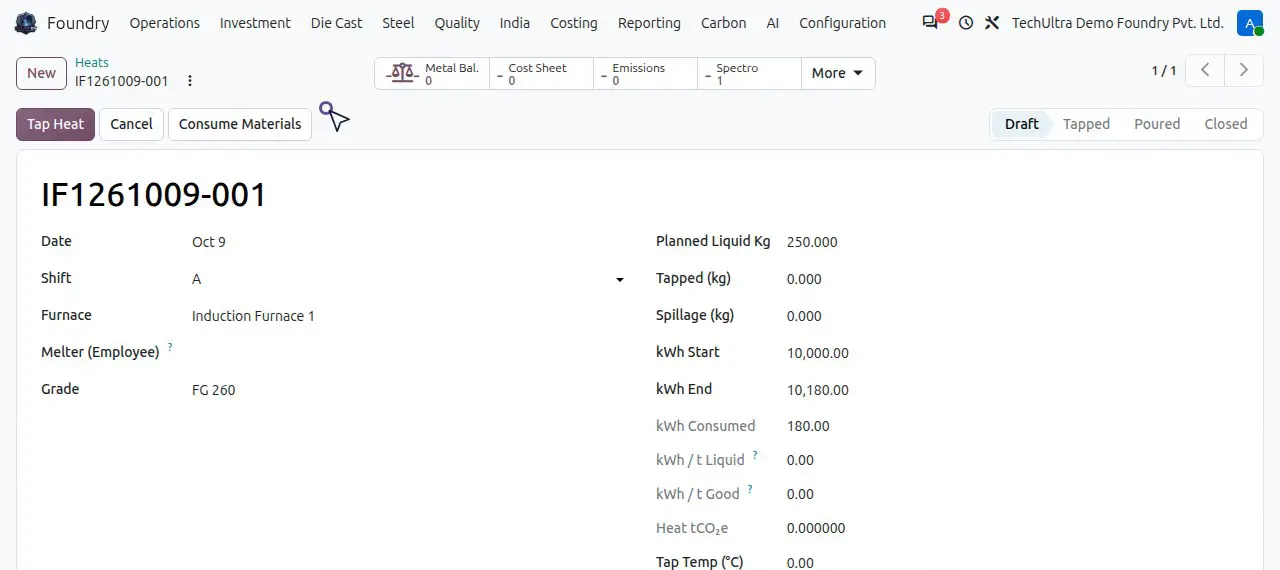
A general ERP thinks in manufacturing orders. A foundry thinks in heats. Ask to see a heat record: the furnace, the grade, the shift, the charge weighed in, the corrections added and the tapped weight. Every other check on this list depends on this one.
Pass if: each casting lot points to the heat it was poured from.
2. Is chemistry checked against the grade before tapping?
The grade holds the chemistry window: carbon, silicon, manganese, sulphur, phosphorus and so on. A spectrometer result should be checked against it automatically, and a failed sample should stop the heat until a metallurgist corrects it.
Pass if: a failed bath sample blocks tapping on screen, not after the castings are poured.
3. Can it trace a casting back to its heat, and forward to the customer?
Take one recent complaint. Ask the vendor to go from the invoice to the delivery, the casting lot, the heat, the charge and the moulding line. Then ask for the reverse: every customer who received castings from one heat.
Pass if: both directions take minutes, not a search through files.
4. Does cost per good kilogram come from each heat’s own data?
An average cost per kilogram hides where money leaks. The system should cost each heat from its own charge, power, returns and rejections, then divide by the good weight that left the fettling shop.
Pass if: two heats of the same grade can show different costs, and the system shows why.
5. Does it plan moulds and track pattern life?
Mould plans should come from open orders, the moulding line and its capacity. Patterns should be issued and returned, counted by moulds made, and blocked when they reach their life limit. Customer-owned patterns need their owner on the record.
Pass if: the planner can build tomorrow’s mould plan from open orders without a spreadsheet.
6. Are rejections recorded by defect, stage and heat?
Every rejected casting carries the full cost of its metal, moulding and fettling. Ask how a rejection is recorded at knockout, fettling and final inspection, with the defect type, quantity, heat and pattern. Then ask how a corrective action, such as an 8D report, is tied to it.
Pass if: you can see rejection by defect and by pattern for last month in one report.
7. Are test certificates built from the heat’s own results?
Many OEM customers ask for an EN 10204 3.1 certificate with each delivery. It should be generated from the chemistry and mechanical results already recorded against the heat, not typed again.
Pass if: the certificate for a delivery fills itself from the heat record.
8. Does it cover outside processing and the export reports your customers ask for?
Foundries send castings out for machining, heat treatment or coating, and the paperwork for that work has to match the stock. Exporters also face new customer questions, such as the embedded emissions EU importers now need under the EU’s carbon border rules. See our guide to CBAM for foundries and casting exporters for what they ask and why.
Pass if: goods sent out and received back reconcile with stock, and emissions per heat can be reported by customer and customs code.
9. Does it run on the same database as purchasing, stock, sales and accounting?
A separate foundry system that syncs with the ERP every night means two versions of stock and two versions of cost. A heat should consume real stock and create a real lot that sales and accounting see straight away.
Pass if: tapping a heat changes stock on hand in the same system, at the same moment.
10. Will you own it?
Ask four questions: who owns the data, what the software licences cost each year, whether you can change or extend the system without the original vendor, and who supports it when something stops on a night shift.
Pass if: the answers are in writing before you sign.
How to run the demo
Send the vendor three things a week before the demo: one real metal grade with its chemistry window, one casting with its pattern and routing, and one recent customer complaint with the heat number. Then score each check while you watch.
| Check | Ask the vendor to show | Pass if |
|---|---|---|
| Heat record | A heat for your grade, from charge to tap | Each casting lot carries the heat number |
| Chemistry | A failed spectrometer sample | Tapping is blocked until it is corrected |
| Traceability | Your complaint, invoice to charge | Done on screen in minutes |
| Cost per kg | Two heats of the same grade | Costs differ, with the reason shown |
| Moulds and patterns | Tomorrow’s mould plan | Built from open orders; pattern life counted |
| Rejections | Last month by defect and pattern | One report, no spreadsheet |
| Certificates | A 3.1 certificate for one delivery | Filled from the heat’s results |
| Outside work and exports | Castings sent out and back; an emissions report | Stock reconciles; report by customs code |
| One database | Tap a heat, then open stock | Stock changes at once |
| Ownership | Licences, data, support in writing | Answers before signing |
A system that passes eight or more checks without a spreadsheet is worth a second meeting. One that passes fewer is a general ERP with a foundry brochure.
What moves the price
Foundry ERP is rarely sold from a price list, so compare what drives the quote rather than the headline figure:
- the number of plants, furnaces and moulding lines
- optional modules, such as investment casting, steel or die casting
- integrations with spectrometers, energy meters or customer portals
- how many years of history move across from the old system
- the yearly software licences, which are separate from the project
Ask each vendor to price the same scope in writing. For the licence side on Odoo, see our Odoo pricing guide.
How TechUltra Foundry answers the checklist
We built TechUltra Foundry on Odoo 20 Enterprise to pass all ten checks on one database: heats with charge and chemistry checked against the grade, heat number traceability from invoice to charge, cost per good kilogram per heat, mould plans and pattern life, rejections with 8D, EN 10204 3.1 certificates, job work challans and CBAM reports by customs code. The foundry ERP software page shows every screen, and a 3-minute video walks a casting from enquiry to invoice.
If you are comparing systems, bring this checklist to our demo too. Book a foundry ERP demo and we will run it on your own grade and casting. For the wider picture of Odoo in a plant, see Odoo for manufacturing.
Frequently asked questions
-
What is the most important feature in foundry ERP software?
Heat records. Chemistry checks, traceability, cost per kilogram and test certificates all depend on the system knowing which heat each casting came from. If the software stops at the manufacturing order, the other checks fail with it.
-
Can a general ERP be configured for a foundry?
Partly. A general ERP handles purchasing, stock, sales and accounting well. It has no heats, charge chemistry, mould plans or pattern life, so those end up in spreadsheets beside it. Run the ten checks in this list on any configured system and see which ones it passes without a spreadsheet.
-
How long should a foundry ERP demo take?
Plan half a day. Give the vendor one of your real grades, one casting with its pattern and one recent customer complaint in advance, and ask them to walk the casting from metal purchase to invoice on screen.
-
What should I ask about price?
Ask what moves the price rather than for a list price: the number of plants, furnaces and moulding lines, the optional modules you need, the integrations, and how much history moves across. Ask separately what the software licences cost each year.
-
Do I need foundry ERP if I only make a few grades?
The grade count matters less than traceability and costing. If customers ask you to trace a casting to its heat, or you cannot say what a good kilogram cost last month, those two questions alone are the case for a foundry ERP.
Related services & solutions
Put this into practice with TechUltra's senior Odoo consultants.
-
Odoo Manufacturing (MRP)
Odoo Manufacturing module — MRP I + MRP II, BOMs, routings, work orders, quality, maintenance, MES. Discrete + process manufacturing. TechUltra Gold Partner.
-
Odoo Inventory + Warehouse Management
Odoo Inventory module — multi-warehouse, batch/serial, putaway, barcode, replenishment, cross-docking, dropship, consignment. Full WMS in your ERP.
-
Odoo Implementation Services — Custom-Scope, Discovery-Led
Odoo implementation partner and Gold Partner since 2021: one-week discovery, fixed-price delivery, 400+ projects and full code ownership. Book a scoping call.
-
Odoo for manufacturing
MRP, shop floor, quality, and multi-plant rollouts on Odoo.