CBAM for Foundries: What Casting Exporters Need to Know in 2026
Which castings the EU's carbon border rules cover today, which may follow from 2028, what your EU importer will ask for, and the heat-level data a foundry needs to answer.

The EU’s Carbon Border Adjustment Mechanism (CBAM) puts a carbon price on certain imports, so they carry the same cost EU producers pay under the EU Emissions Trading System. Since 1 January 2026 it has applied in full: EU importers of covered goods will buy and surrender certificates for the emissions embedded in what they import.
For a foundry outside the EU, that raises three practical questions: are my castings covered, what will my importer ask me for, and can my systems produce it? This guide answers each one from the regulation and the Commission’s own guidance.
The dates that matter
| Date | What happens |
|---|---|
| 1 October 2023 to 31 December 2025 | Transitional period: importers reported emissions, with no payment |
| 1 January 2026 | Definitive period begins |
| 1 February 2027 | Sale of CBAM certificates to authorised declarants starts |
| 30 September 2027 | Certificates for 2026 imports surrendered |
| 1 January 2028 | Proposed start for downstream products, including 7325 castings (not yet law) |
| 2034 | Embedded emissions fully covered, as EU free allocation ends |
Importers that bring in less than 50 tonnes of CBAM goods a year are exempt, under the 2025 simplification (Regulation (EU) 2025/2083). Above that, the importer must be an authorised CBAM declarant.
Are your castings covered today?
CBAM covers goods by their Combined Nomenclature (CN) code, listed in Annex I of Regulation (EU) 2023/956. In chapter 73, only the listed headings are in scope. For a foundry, the split looks like this:
| CN heading | Description | In CBAM today? |
|---|---|---|
| 7201 | Pig iron in pigs, blocks or other primary forms | Yes |
| 7206, 7207, 7218, 7224 | Steel ingots and semi-finished products | Yes |
| 7303 | Tubes, pipes and hollow profiles, of cast iron | Yes |
| 7307 | Tube or pipe fittings of iron or steel | Yes |
| 7325 | Other cast articles of iron or steel | No, proposed from 2028 |
| 7326 | Other articles of iron or steel | Yes |
| Chapters 84 and 87 | Machinery and vehicle parts, such as pump bodies or gearbox housings | No, some parts proposed from 2028 |
| 7601 | Unwrought aluminium | Yes |
| 7616 | Other articles of aluminium | Yes |
| 7615 | Aluminium household articles | No, excluded |
Two points catch exporters out. First, the same casting can sit under different codes depending on what it is for: a valve body, a pump casing and a plain cast weight may all be classified differently. Second, the importer declares the code, not you, so agree it with them before you build any report.
What may be added from 2028
On 17 December 2025 the Commission proposed extending CBAM to about 180 downstream products with a high steel or aluminium content (COM(2025) 989). The list names heading 7325, other cast articles of iron or steel, and several vehicle and machinery parts, such as gearboxes, road wheels and suspension parts under 8708, and parts of agricultural machinery under 8432. The proposed start is 1 January 2028.
It is a proposal, not law. The European Parliament has adopted its position, and the final list and date depend on the agreement with the Council. If your castings are under 7325 or one of the named parts, plan for it now: the data you need is the same.
What your EU importer will ask for
The importer needs the embedded emissions of each covered good, in tonnes of CO2 equivalent per tonne of product, by installation. For iron and steel, Commission guidance says indirect emissions from electricity were reported only during the transitional period; the definitive-period obligation is on direct emissions.
In practice, expect requests for:
- the tonnes delivered to that importer in the period, by CN code
- direct emissions from fuels and process materials, such as gas, coke and electrodes
- the emissions of relevant precursors in your charge, such as pig iron and ferro-alloys, ideally from your suppliers
- the share of post-consumer scrap, which the guidance treats as having zero embedded emissions in the electric arc furnace steel route
- the method you used, so the importer can show it to a verifier
If you cannot supply actual data, the importer falls back on default values published by the Commission. Your actual figures may come out lower or higher than the default, but only actual data reflects your own charge mix and furnaces, and an importer choosing between suppliers will notice who can provide it.
The data a foundry needs, heat by heat
CBAM emissions are calculated per installation and production process, but the useful unit inside a foundry is the heat. If each heat records its charge, fuels, power and output, the report for any importer and period is a sum:
- Charge: every material weighed into the furnace, with its source and, for pig iron and ferro-alloys, the supplier’s emissions figure.
- Energy: fuel used and energy meter readings at start and end of the melt.
- Output: tapped weight, then the good castings that came from it.
- Delivery: which casting lots went to which customer, under which CN code.
When that chain exists, a CBAM report is a query, not a project. When it does not, it is a spreadsheet rebuilt every quarter from invoices and furnace logbooks.
How TechUltra Foundry handles it
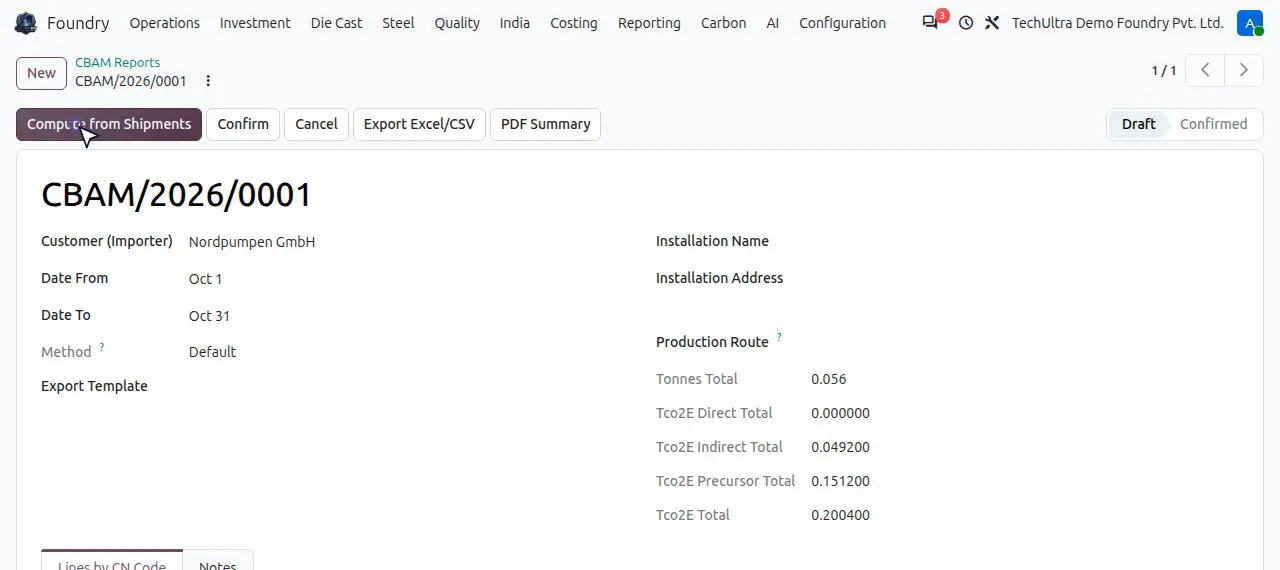
TechUltra Foundry runs on Odoo 20 Enterprise and records each heat with its charge, corrections, power readings and tapping. Each heat carries its own tCO2e from power, fuels and raw materials. A CBAM report for an EU importer and period reads your deliveries, groups them by CN code, and totals tonnes and direct, indirect and precursor emissions, ready to export to Excel or CSV or as a PDF summary for the importer.
Because the same heat feeds traceability, cost per kilogram and the EN 10204 3.1 certificate, the emissions figure comes from records the plant already keeps. If you are choosing a system, our 10-point foundry ERP checklist covers what to test, or book a foundry ERP demo to see the CBAM report on demo data.
Sources
- European Commission, Carbon Border Adjustment Mechanism: definitive period from 1 January 2026.
- European Commission, CBAM guidance for importers: Annex I goods tables for iron, steel and aluminium; indirect emissions for iron and steel; scrap treatment; phase-in to 2034.
- Gleiss Lutz, EU simplifies CBAM Regulation with the Omnibus: the 50-tonne annual threshold per importer under Regulation (EU) 2025/2083.
- German Emissions Trading Authority (DEHSt), CBAM certificates: certificate sales from February 2027 and surrender by 30 September.
- European Parliamentary Research Service, CBAM extension to downstream products: COM(2025) 989 of 17 December 2025, about 180 downstream products.
- Inside Energy & Environment, Commission proposes expansion to complex metal products: proposed annex including 7325 and 8708 parts; start 1 January 2028.
- EUROMETAL, Parliament adopts position on the downstream extension.
This guide explains the rules; it is not legal or customs advice. Confirm CN codes and reporting with your EU importer.
Frequently asked questions
-
Are iron castings covered by CBAM?
It depends on the CN code. Heading 7325, other cast articles of iron or steel, is not in CBAM Annex I today. Cast iron tubes and pipes (7303), tube or pipe fittings (7307) and other articles of iron or steel (7326) are. Castings classified as machinery or vehicle parts in chapters 84 and 87 are not in the current list. Your EU importer confirms the code.
-
Are aluminium castings covered by CBAM?
Often, yes. Heading 7616, other articles of aluminium, is in CBAM Annex I, as are unwrought aluminium (7601) and most other chapter 76 headings. Household articles under 7615 and aluminium scrap under 7602 are excluded.
-
When do CBAM costs start?
The definitive period began on 1 January 2026. Authorised declarants buy CBAM certificates from 1 February 2027 for goods imported in 2026, and surrender them by 30 September 2027. The importer pays, but the price depends on the emissions data you supply.
-
Who has to comply, the foundry or the importer?
The EU importer, as an authorised CBAM declarant. Importers below 50 tonnes of CBAM goods a year are exempt. The foundry outside the EU supplies the embedded emissions per tonne; without it, the importer uses default values, which are usually less favourable.
-
Does scrap-based melting lower CBAM emissions?
It can. Commission guidance treats post-consumer scrap as having zero embedded emissions in the electric arc furnace steel route, so the charge mix matters. Pig iron and ferro-alloys are relevant precursors and carry their own emissions.
-
Will 7325 castings be covered from 2028?
The Commission proposed it on 17 December 2025, in a package adding about 180 downstream steel and aluminium products from 1 January 2028. It is still in the legislative process, so the final list and date may change.
Related services & solutions
Put this into practice with TechUltra's senior Odoo consultants.
-
E-Invoicing on Odoo
Native e-invoicing for Odoo — India GST, Italy FatturaPA, Saudi ZATCA, Mexico CFDI, EU EN 16931. IRN registration, statutory submission, audit archives.
-
ZATCA E-Invoicing for Odoo (Saudi Arabia)
ZATCA Phase 2 Fatoora integration for Odoo — cryptographic stamping, real-time clearance, simplified invoice reporting, TLV QR codes, CSID, 6-year archive.
-
UAE E-Invoicing on Odoo
UAE e-invoicing on Odoo: AED 50m+ businesses appoint an ASP by 30 Oct 2026 and go live 1 Jan 2027, others 1 Jul 2027. PINT AE via your ASP. Book a check.
-
Odoo Accounting Services
Outsourced Odoo accounting & bookkeeping services. 15-person CA-led team. Daily bookkeeping, month-end, GST/VAT, payroll. From $15/hour. Worldwide.