Odoo Gold Partner — Implementation
Odoo Implementation Services — Custom-Scope, Discovery-Led
Odoo ERP implementation by an Odoo Gold Partner: a one-week discovery, a fixed price before configuration starts, then an 8–14 week build and 90 days of hypercare after go-live. 400+ Odoo projects delivered since 2016, full code ownership and no third-party outsourcing.
Free 30-minute call with a senior consultant · Reply within 1 business day
The consultant who scopes your project is the consultant who runs it. There is no handover from a salesperson to a delivery team after you sign — the part of an ERP engagement that most often goes wrong.
Last reviewed:
-
Discovery 1 week
-
Blueprint 1 week
-
Build 8–14 weeks
-
User acceptance testing 2 weeks
-
Go-live 1 weekend
-
Hypercare and handoff 90 days
- Fixed price after the one-week discovery
- Named senior consultant from scoping to go-live
- 90 days of hypercare after go-live
What should an Odoo implementation partner commit to before you sign?
A scope, a price and a date, in writing, before the first configuration call. We run a one-week discovery first, because the alternative is a fixed price quoted against an unread requirement, which is how ERP projects overrun. Discovery produces the process map, the integration list, the data-migration plan and a fixed-scope, fixed-price statement of work, and if you take that document to a different partner instead, it is yours to keep. TechUltra has been an Odoo Gold Partner since 2021, has delivered more than 400 Odoo projects since 2016, and publishes 101 enterprise implementations as checkable references on Odoo's own partner directory. Thirteen Odoo certifications span Odoo 15 to 19, covering every version you might be upgrading from. Ask any partner you shortlist for the same three things: directory references, certification versions, and a written scope before payment.
What's included
-
One-week discovery
Process mapping, current-system audit, gap analysis, and a written diagnostic. Output usable on its own even if you don't proceed.
-
Fixed-scope blueprint
Module map, integration list, custom-development scope, data-migration plan, training plan, and a written quote. No hourly billing surprises.
-
Module configuration
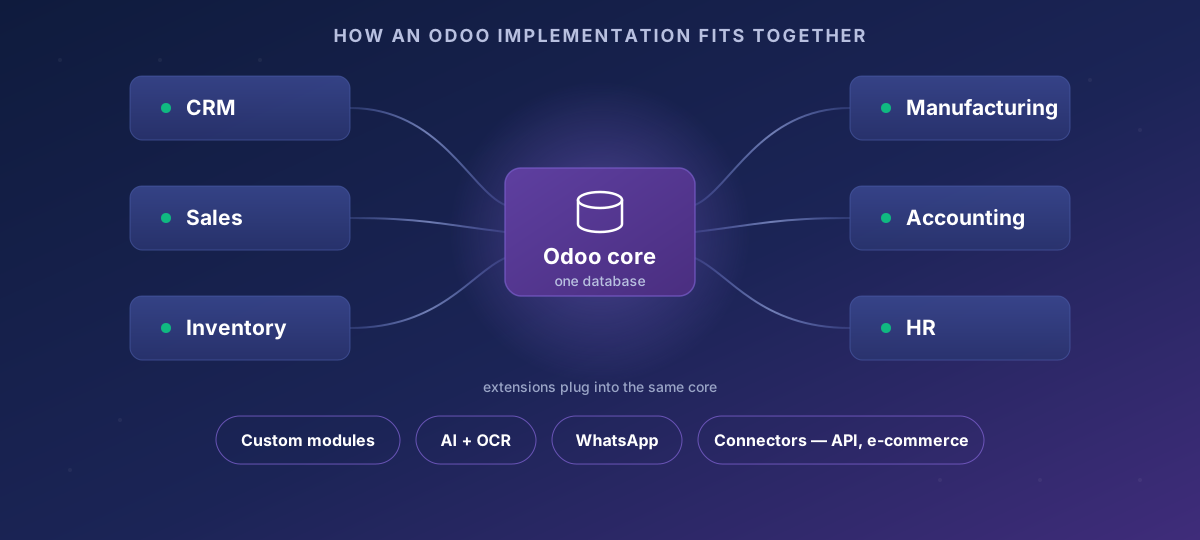
All standard Odoo modules configured to your business processes — Sales, Purchase, Inventory, Manufacturing, Accounting, HR, Project, and CRM as scoped.
-
Custom modules and workflows
Python-based custom development for behavior the standard modules don't cover, written to upgrade-safe patterns.
-
Data migration
Master-data and transactional-data migration from your current system, including parallel-run reconciliation and a clean cutover.
-
Integrations
Two-way connectors to your CRM, payment gateway, shipping carriers, e-commerce, and any vertical SaaS your team relies on.
-
Role-based training
On-site or remote training for end users, super-admins, and finance/operations leadership. Recorded sessions and a playbook for ongoing onboarding.
-
90-day hypercare
Dedicated post-launch support team for 90 days, average 18-minute first-response time during business hours, with a clean handoff to retainer or on-demand support.
Our process
- 01 Discovery 1 week
- 02 Blueprint 1 week
- 03 Build 8–14 weeks
- 04 User acceptance testing 2 weeks
- 05 Go-live 1 weekend
- 06 Hypercare and handoff 90 days
-
Discovery
1 weekOne-week deep dive into your current ERP, processes, and target outcomes. Output: a written diagnostic with module map and risk register.
-
Blueprint
1 weekFixed-scope quote, module configuration spec, custom-dev list, integration plan, data-migration approach, and training plan — all signed off before build.
-
Build
8–14 weeksIterative two-week sprints with weekly demos. Your team gets UAT environment access from week one for hands-on review and feedback.
-
User acceptance testing
2 weeksReal-data UAT with end users running their actual workflows. Sign-off checklist, bug triage, and role-specific training before cutover.
-
Go-live
1 weekendCutover weekend with a documented and rehearsed rollback plan. 72 hours of on-call cover over cutover, inside the 90-day hypercare.
-
Hypercare and handoff
90 days90 days of dedicated post-launch support with a named team, then transition to a retainer or on-demand engagement of your choice.
Who owns what, stage by stage
So you can plan your team's time before you sign, not after.
Discovery
Blueprint
Build
User acceptance
Go-live
Hypercare
Your team
Process walkthroughs; access to the current ERP and its data
Sign off the fixed-scope quote and the configuration spec
Weekly demo review, and hands-on feedback in UAT from week one
End users run their real workflows; sign-off checklist
Availability across the cutover weekend
Raise issues through the named channel
TechUltra
A written diagnostic with a module map and a risk register
Quote, config spec, custom-dev list, integration and migration plans
Iterative two-week sprints, with a UAT environment available from week one
Bug triage and role-specific training before cutover
Rehearsed rollback plan; 72 hours of on-call cover
90 days of dedicated support with a named team
-
Discovery
- Your team
- Process walkthroughs; access to the current ERP and its data
- TechUltra
- A written diagnostic with a module map and a risk register
-
Blueprint
- Your team
- Sign off the fixed-scope quote and the configuration spec
- TechUltra
- Quote, config spec, custom-dev list, integration and migration plans
-
Build
- Your team
- Weekly demo review, and hands-on feedback in UAT from week one
- TechUltra
- Iterative two-week sprints, with a UAT environment available from week one
-
User acceptance
- Your team
- End users run their real workflows; sign-off checklist
- TechUltra
- Bug triage and role-specific training before cutover
-
Go-live
- Your team
- Availability across the cutover weekend
- TechUltra
- Rehearsed rollback plan; 72 hours of on-call cover
-
Hypercare
- Your team
- Raise issues through the named channel
- TechUltra
- 90 days of dedicated support with a named team
Typical timeline
A typical mid-market implementation (50–500 employees, 4–8 modules, 3 integrations) runs 12–20 weeks from kickoff to go-live. Smaller starter projects with 2–3 modules and clean data ship in 6–8 weeks. Large multi-entity rollouts run 6–9 months, phased by business unit. The biggest variable is data quality in your current system — clean data accelerates everything; messy data adds 2–4 weeks for cleanup. We share a week-by-week schedule during blueprint so dependencies on your team are visible upfront.
What affects the price
Every engagement is fixed-scope after a one-week discovery. These are the levers that move a quote up or down.
-
Licence mix: full users and Light Users
Not our fee, but usually the biggest number in the budget. Since Odoo 20, staff who only need time off, expenses, attendance, shop-floor, barcode or field-service screens can be Light Users (₹195 per user per month in India on Odoo's price list, 22 October 2026) instead of full users. Discovery models the split before you order.
-
Number of modules
Each module adds configuration time. A 3-module starter (Sales + Inventory + Accounting) is faster to scope than a 12-module ERP-wide rollout.
-
Custom-development scope
Standard Odoo handles ~80% of common requirements out of the box. The remaining 20% — custom workflows, vertical-specific reports, unusual approval chains — drives most of the variable cost.
-
Integrations
Each connector to a third-party system (CRM, e-commerce, payment, shipping, vertical SaaS) is roughly 1–3 weeks of work depending on complexity and the third party's API quality.
-
Data-migration complexity
Migrating from a clean modern system is fast. Migrating from a legacy ERP with inconsistent data, custom fields, or no API costs more — usually 2–4 weeks of additional cleanup.
-
Number of countries / entities
Multi-country rollouts add localization (tax, e-invoicing, statutory reports) and consolidated reporting. Each additional entity adds 1–2 weeks.
-
Training depth
Standard role-based training is included. Train-the-trainer programs, recorded course libraries, and ongoing onboarding kits are scoped separately.
Who this is for
Mid-market SMEs and MSMEs (50–500 employees) replacing a legacy ERP, outgrowing accounting software like QuickBooks or Tally, or consolidating multiple disconnected tools. We focus on companies that want a single fixed-scope partner rather than juggling a system integrator and multiple specialist vendors. If you're under 25 employees and don't have an internal IT lead, our Hire-Odoo-Developer engagement may be a better fit; if you're a 5,000-person enterprise needing white-glove change management, we'll honestly tell you so and refer you to a Big-4 partner.
Why TechUltra for Odoo Implementation
-
Senior consultants on every engagement
Every project is led by a 5+ year Odoo specialist — never a junior. The same person who scopes the project also runs the build. No discovery handoff to a less experienced delivery team.
-
Fixed-scope, no hourly surprises
We quote fixed price after a one-week discovery. Change requests are handled through a documented change-control process, not surprise invoices.
-
Upgrade-safe custom development
Our custom modules use Odoo's recommended extension patterns so they survive version upgrades without a rewrite. We've upgraded clients from Odoo 15 → 19 across major version jumps with minimal customization rework.
400+
projects delivered
101
references on Odoo's partner directory
2021
Odoo Gold Partner since
Featured case studies
- IT Services & Hardware
Axiom Technologies
Implemented Odoo 17 Enterprise for a global IT-services partner across Australia, EMEA, and North America. 7 modules unified — CRM, sales, purchase, project, planning, HR — in 14 weeks.
Read case study7
Modules unified
- Fusion Energy / Advanced Manufacturing
Commonwealth Fusion Systems
Optimized and customized Odoo for a US fusion-energy pioneer scaling from initial adoption (2021) to 1000+ users — 4 core modules, with US-timezone real-time support.
Read case study1000+
Active Odoo users
Frequently asked questions
-
How do we choose an Odoo implementation company?
Check three things any partner can prove. References on Odoo's own partner directory, where implementations are published by the partner and visible to anyone; TechUltra lists 101. Certifications and the versions they cover; ours are 13, spanning Odoo 15 to 19. And a written scope, price and date before you pay anything, which is what our one-week discovery produces. Gold Partner status (TechUltra's since 2021) is a useful first filter because Odoo re-audits it every year, but it is not a substitute for the three checks.
-
Should we buy implementation from Odoo S.A. directly or from a partner?
Odoo S.A. sells implementation as blocks of consultant hours focused on configuring standard Odoo. A Gold Partner delivers a fixed-scope project that also covers custom development, integrations, data migration, training and post-go-live support, and can sell the same hour-based packs for small scopes; see our Odoo Success Pack. If your scope is small and standard, a pack is a sensible buy. If it involves custom code, more than one system or more than one country, a fixed-scope partner project is the safer one.
-
How long does an Odoo implementation typically take?
For mid-market deployments (50–500 employees), our typical timeline is 12–20 weeks from kickoff to go-live: 1 week discovery, 1 week blueprint, 8–14 weeks build, 2 weeks UAT, then a cutover weekend. Larger multi-entity rollouts run 6–9 months phased by business unit. Smaller starter projects with 2–3 modules can ship in 6–8 weeks.
-
How much does an Odoo implementation cost?
Projects start from about USD 4,000 for a small, standard setup and go up with scope: module count, custom development, integrations and how clean your existing data is. Beyond that starting point there is no price list: a one-week discovery maps your processes and ends with a fixed price, so the number you sign is the number you pay. Only need a few modules set up? An Odoo Success Pack gives you a fixed block of consultant hours, from 25 hours. Licence costs are on Odoo pricing.
-
Do you handle the data migration from our existing system?
Yes — data migration is included in every implementation. We've migrated from SAP Business One, NetSuite, Microsoft Dynamics, Tally, Zoho, QuickBooks, custom-built ERPs, and Odoo itself across version jumps. The migration includes master data, transactional history (configurable depth), parallel-run reconciliation, and a clean cutover.
-
What if we need custom features Odoo doesn't have?
If Odoo doesn't have a feature you need, our team writes custom Python modules using Odoo's recommended extension patterns — so customizations survive future version upgrades. Odoo's standard modules cover ~80% of mid-market requirements out of the box; custom development covers the remaining 20%. Custom scope is fixed at blueprint and quoted upfront.
-
Will my customizations survive future Odoo upgrades?
Yes — we follow Odoo's official extension patterns (inheriting from base models, using upgrade-safe field definitions, avoiding monkey-patching) specifically so clients can move between major versions without rewriting customizations. We've upgraded clients from Odoo 15 to 19 with minimal rework.
-
Do you provide training for our team?
Every implementation includes role-based training: end-user training (live sessions, recorded), super-admin training, and finance/operations leadership briefings. We can also run train-the-trainer programs so you can onboard new hires internally without involving us.
-
What happens after go-live?
Every engagement includes 90 days of dedicated post-launch hypercare from a named team — average 18-minute first-response during business hours, 4 hours overnight. After hypercare, you can transition to a monthly retainer (predictable cost, includes upgrades) or on-demand support (pay only for issues). All support is run by the same team that built your system.
-
Can you implement Odoo across multiple countries?
Yes — we've shipped multi-country rollouts spanning India, the UK, South Africa, Peru, Italy and France, each with localized tax, statutory reporting, e-invoicing, and currency handling. Multi-country implementations are usually phased: lead market first (typically the largest revenue or most complex), then expand. Phased rollouts reduce blast radius and let the lead market act as the reference for downstream entities.
-
Will you work with our existing IT or finance team?
Always — our default delivery model is a small TechUltra team paired with a small client team, usually a project sponsor on your side plus an IT lead and the operational leads for each module. We document everything in a shared workspace; nothing is locked in our heads. Client teams routinely take over day-two operations within 90 days of go-live.